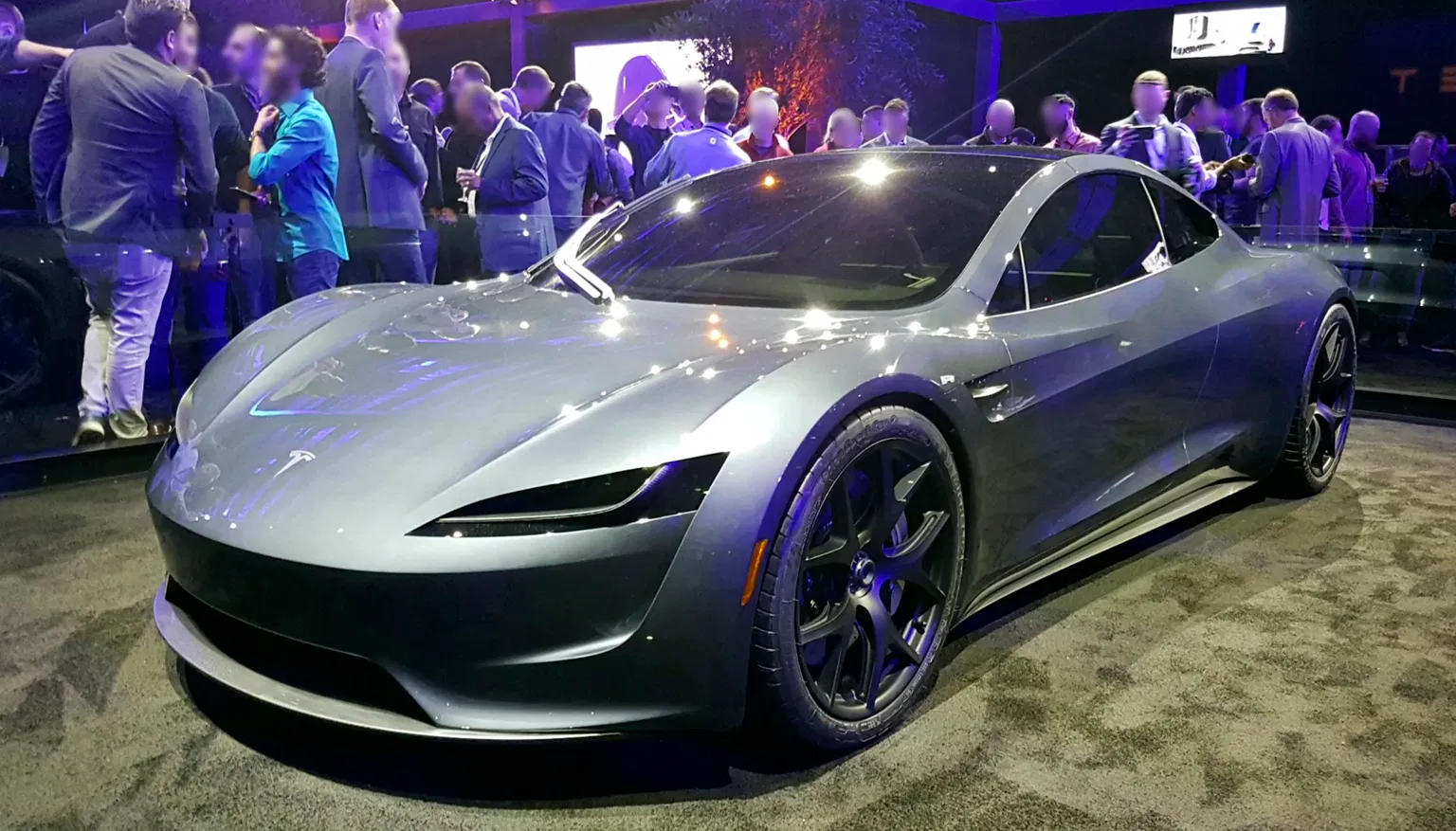
Nearly nine years after it was first teased in 2017, Tesla's second-generation Roadster finally graduated from CGI renders into "wait, did that car just fly?" territory. At a live event on October 15, 2026, held at SpaceX's rocket-testing facility in McGregor, Texas, the electric supercar drove up a curved ramp until it was upside down, launched off the end, flipped itself upright in mid-air, and hovered for a few moments before touching down. The demo, performed autonomously with a "Starman" mannequin in the driver's seat, instantly revived the internet's favorite question: is Tesla actually building a flying car?
The honest answer is more interesting than a simple yes or no. The Roadster does not fly the way an airplane or helicopter does, and it cannot cruise through the sky. Instead, it leans on two separate aerospace tricks — SpaceX cold-gas thrusters and a fan-powered suction system — to make short, controlled hops. Here is how the technology actually works, what it can and cannot do, and how it fits into the much bigger race to build real flying cars.
What Tesla Showed in Texas
The centerpiece of the reveal was a limited-edition Roadster fitted with SpaceX-developed cold-gas thrusters. In the most memorable sequence, the car climbed a steep, curved track until it was hanging inverted, held against the surface by powerful fans beneath its body. It then left the ramp, rotated in the air, and settled back to the ground. Musk framed the live audience as proof the stunt was real, telling the crowd, "we need an audience to prove that it's not AI or SI," and pledging the car would reach production in 2028.
The numbers are as wild as the visuals. Tesla says the Roadster reaches 60 mph in under one second — as little as 0.81 seconds in some reports — with a top speed above 230 mph and more than 300 miles of range. The flying flagship is the "Rocket" variant; a "Thrust" version pairs a 200-litre cold-air system with four rear nozzles for the brutal acceleration. But the star of the show is the thruster package, which is worth unpacking in detail.
How Cold-Gas Thrusters Work
A cold-gas thruster is the simplest kind of rocket engine, and the operative word is "cold." A conventional rocket burns fuel and an oxidizer to create a hot, high-pressure exhaust. A cold-gas thruster skips combustion entirely: it simply vents a pressurized gas through a nozzle. The gas expands as it escapes, and Newton's third law does the rest — pushing gas backward shoves the vehicle forward, upward, or in whatever direction the nozzle points.
On the Roadster, that gas is compressed nitrogen, an inert, non-flammable gas that makes up nearly 80 percent of the air we breathe. It is stored in high-pressure tanks — SpaceX-style composite overwrapped pressure vessels, or COPVs — and released through roughly ten small thrusters arranged around the car. Because there is no combustion, there is no flame and no toxic exhaust, which is precisely why this technology has been used for decades on spacecraft for gentle, precise attitude control.
The trade-off is energy density. Compressed gas holds far less energy per kilogram than liquid fuel, so cold-gas thrusters are ideal for short, precise bursts — perfect for nudging a spacecraft or briefly lifting a car — but useless for sustained flight.
The Suction System That Let It Drive Upside Down
The upside-down driving was a separate trick. To cling to the underside of a track, the Roadster uses a fan system that pulls air from beneath the car, creating a low-pressure zone that effectively sucks the vehicle onto the surface. This ground-effect downforce is not new: race engineers experimented with suction fans in the 1970s, most famously the Brabham BT46 "fan car," before regulators banned the idea. Tesla has revived it at an extreme scale.
It is important to separate the two systems. The suction fans hold the car against a surface, while the cold-gas thrusters provide the push and the mid-air attitude control. Combine them, and you get a vehicle that can drive where gravity says it should not and briefly maneuver through the air — but only for a few seconds at a time.
Why the Roadster Isn't a True Flying Car
Calling the Roadster a flying car flatters it. A real flying car — the kind companies such as Joby Aviation and Archer are building — is an eVTOL, short for electric vertical take-off and landing aircraft. Instead of cold-gas thrusters, eVTOLs use batteries and electric motors to spin multiple rotors or tilting propellers, generating sustained lift and forward flight the way a large drone or helicopter does.
Most eVTOLs fall into two broad designs. In a lift-plus-cruise configuration, separate rotors handle vertical takeoff while a fixed wing and a dedicated propeller carry the aircraft forward. In a tiltrotor design, the same rotors tilt from pointing up, for hover, to pointing forward, for cruise, transitioning the vehicle between two flight modes. Both approaches hinge on the same idea that makes drones so efficient: distributed electric propulsion, which spreads thrust across many small motors instead of one big engine.
The physics gap is enormous. Hovering even a lightweight aircraft demands continuous power, and batteries still cannot store as much energy per kilogram as jet fuel. Most all-electric eVTOLs are limited to roughly 60 to 100 miles of range — enough for short urban air-taxi hops, but nowhere near road-trip territory. The Roadster's compressed-air thrusters store even less energy, so its "flight" lasts moments rather than minutes.
Then there are the hurdles every flying car faces: certification, air-traffic integration, noise, safety standards, and cost. Joby and Archer have spent years and billions getting prototypes certified for piloted test flights, and commercial air-taxi service is still rolling out city by city.
Where the Roadster Stands Now
Tesla has not announced final pricing, but the structure is taking shape. Reservations reopened with deposits ranging from $50,000 for the base Performance trim to $250,000 for the Thrust version; the Rocket trim is invite-only with no public price. That echoes the original 2017 pitch of a $200,000 base car and a $250,000 Founders Series. Production is targeted for 2028 — nine years after the car was first shown and after a long list of delays.
In the meantime, the Roadster's trick tech works as a rolling proof of concept for SpaceX hardware outside a spacecraft. But for anyone hoping to skip traffic by air, the honest takeaway is simple: the Roadster hops, flips, and accelerates like nothing else on four wheels, but it does not fly to work.
What's Next for Flying Cars
Even if the Roadster is not a commuter aircraft, the flying-car industry around it is moving faster than ever. eVTOL makers are targeting commercial air-taxi launches in major cities, with Joby and Archer leading certification efforts in the U.S. and abroad. Battery energy density is the main bottleneck: typical lithium-ion cells plateau around 250 to 300 watt-hours per kilogram, and pushing past that toward 500 Wh/kg and beyond is what could unlock longer ranges and wider routes.
Tesla's contribution is more theatrical than practical — a spectacle that showcases thrusters, suction, and electric torque in a single package. But the underlying technologies, from electric propulsion to distributed fans to cold-gas control, are the same building blocks the broader flying-car industry is refining. When real, long-range flying cars finally arrive, they will look less like a Roadster with rockets and more like an electric helicopter with wings.
The Bottom Line
Key points to remember:
- The Roadster "flew" at its October 15, 2026 reveal using SpaceX cold-gas thrusters and a fan-based suction system.
- Cold-gas thrusters vent pressurized nitrogen through nozzles — no combustion, no flame — for short, precise bursts of thrust.
- Suction fans, not rockets, let the car drive upside down; the thrusters handle the mid-air flip and hover.
- It is a "hopper," not a true flying car: compressed gas stores far less energy than jet fuel or even batteries.
- Real flying cars (eVTOLs such as Joby and Archer) use electric rotors for sustained lift and face battery, range, and certification limits.
- Reservations run from $50,000 to $250,000 across three trims, with production targeted for 2028.