Today marks a historic moment in space exploration as NASA's Artemis 2 mission prepares for its dramatic return to Earth. After a record-breaking journey around the moon, the four astronauts aboard the Orion capsule are scheduled to splash down in the Pacific Ocean at 8:07 PM EDT, completing humanity's first crewed lunar mission in over 50 years. This carefully timed event represents the culmination of years of planning and engineering, with every minute of the descent precisely calculated to ensure the crew's safe return from nearly 250,000 miles away.
How Artemis 2's Return to Earth Unfolds: The 13-Minute Descent
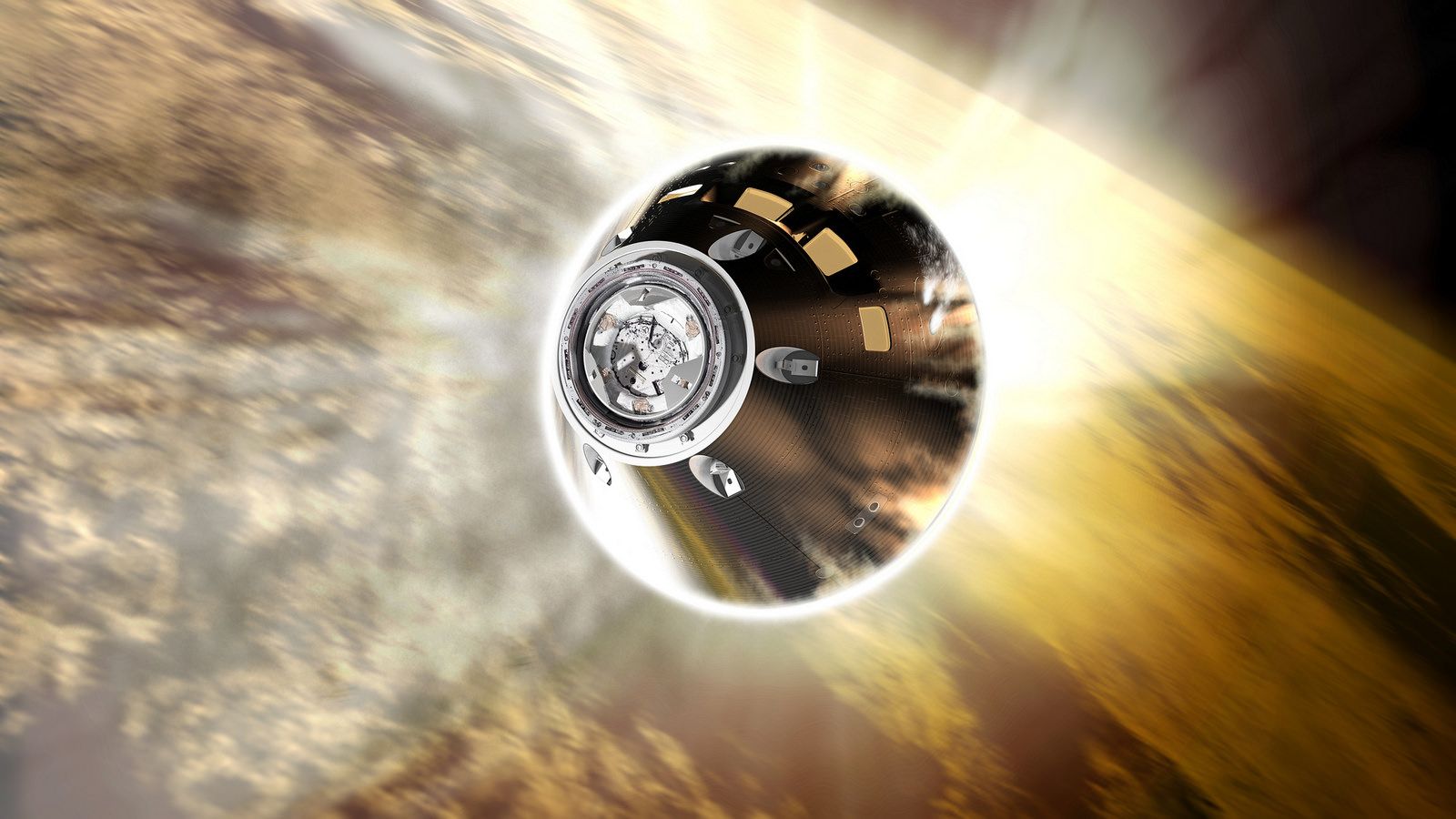
The most critical phase of Artemis 2's homecoming lasts just 13 minutes, but it's a period filled with extreme physics and engineering marvels. At approximately 7:53 PM EDT, the Orion capsule will re-enter Earth's atmosphere at an altitude of 400,000 feet while traveling at a staggering 24,000 miles per hour. During the first two minutes of descent, the spacecraft will plunge 200,000 feet as atmospheric compression creates temperatures reaching 5,000 degrees Fahrenheit—hot enough to vaporize most metals.
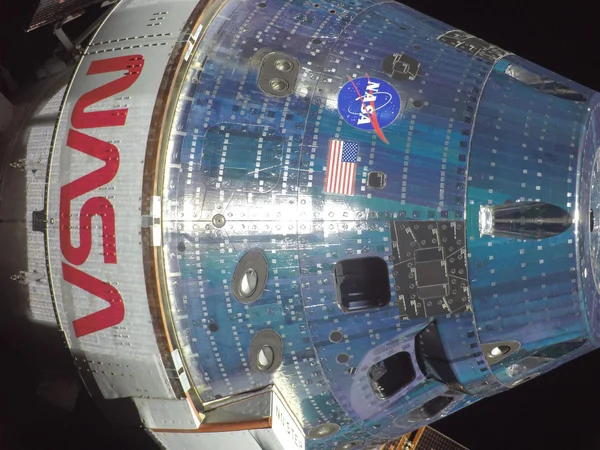
Orion's survival depends on its revolutionary heat shield, the largest ever built for human spaceflight at 16.5 feet in diameter. Unlike previous designs, this shield is engineered to char, melt, and disintegrate in a controlled manner, carrying heat away from the crew module through a process called ablation. "It's 13 minutes of things that have to go right," NASA officials have emphasized about the re-entry sequence. The capsule will also experience a six-minute communications blackout as plasma forms around the vehicle, cutting off contact with mission control during the most intense heating period.
Hour by Hour: The Final Day of Artemis 2's Journey
The astronauts' final day in space begins at 11:35 AM EDT when mission control wakes the crew of Reid Wiseman, Victor Glover, Christina Koch, and Jeremy Hansen. Their first task involves configuring Orion's cramped cabin for re-entry, stowing away equipment and ensuring everything is secured for the potentially bumpy descent. At approximately 1:50 PM, they'll don their specialized pressure suits designed to protect them during the high-G forces of re-entry.
NASA has scheduled a final trajectory correction burn for 2:53 PM if needed to fine-tune Orion's path toward its precise splashdown target. About 42 minutes before splashdown, at 7:37 PM, the spacecraft will jettison its service module—the cylindrical section that provided power, propulsion, and life support during the mission. This separation is critical because only the conical crew module is designed to survive re-entry.
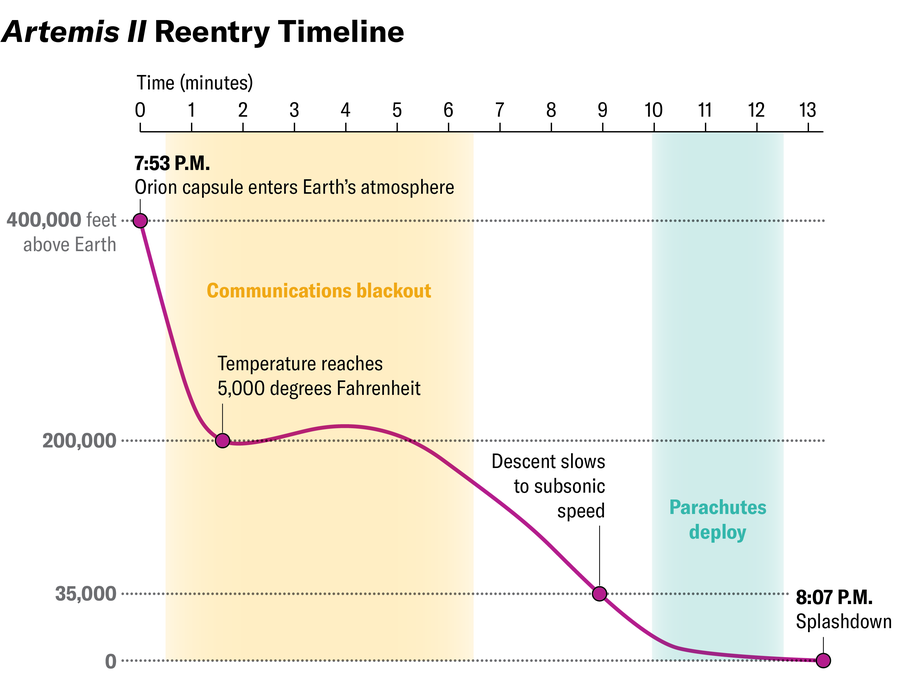
The parachute sequence represents one of the most complex aspects of the descent. At nine minutes into re-entry, when Orion is traveling just under the speed of sound at 35,000 feet, the capsule begins deploying its four sets of parachutes. First come the forward bay cover parachutes, followed by the drogue chutes that stabilize the vehicle and slow it from 24,000 feet to 6,800 feet. Pilot chutes then deploy, finally giving way to the three massive main parachutes—each 116 feet in diameter—that guide the spacecraft gently down to the water at about 17 miles per hour.
The Science Behind Surviving Re-Entry: How Orion's Heat Shield Works
Understanding how Orion survives the incredible heat of re-entry requires delving into materials science and physics. The heat shield consists of a titanium skeleton covered with a fiberglass-phenolic honeycomb structure filled with Avcoat—an ablative material that slowly burns away during re-entry. As Avcoat vaporizes, it carries heat away from the capsule through both physical removal of material and chemical endothermic reactions.
NASA engineers have tested this system extensively, including during the uncrewed Artemis 1 mission in 2024 that validated the heat shield's performance. The shield must protect not only against extreme temperatures but also against plasma formation that can interfere with communications and navigation systems. Orion's design includes a unique "skip re-entry" capability that allows it to bounce off the atmosphere like a stone skipping on water, providing more control over the landing site—a technique not used since the Apollo era.
Where Recovery Stands: Navy Ships Ready for Retrieval
Even before Orion splashes down, recovery forces are positioned and ready. The USS John P. Murtha, an amphibious transport dock ship, stands by approximately 10 nautical miles from the planned splashdown site off the coast of San Diego, California. Aboard the ship, a combined team of NASA engineers, U.S. Navy divers, and medical personnel prepare for what they call "the most complex maritime recovery operation since Apollo."
"We'll push in to recover the astronauts one by one," explained Lt. Julia Buckner, a Seahawk helicopter pilot involved in the operation. Within minutes of splashdown, Navy divers in rigid-hull inflatable boats will approach the capsule to secure it with a flotation collar that prevents sinking. They'll then conduct initial safety checks before opening the hatch and assisting the astronauts out of the spacecraft. Helicopters will transport the crew to the Murtha, where they'll undergo preliminary medical evaluations before beginning their journey back to Houston.
After Splashdown: What Happens to the Artemis 2 Crew
Once safely aboard the recovery ship, the astronauts face several hours of procedures before their mission officially ends. Medical teams will monitor their adaptation to Earth's gravity after 10 days in weightlessness, checking for conditions like orthostatic intolerance (difficulty standing) and fluid shift complications. NASA psychologists will also assess their mental state after the intense mission.
The Orion capsule itself becomes a valuable source of engineering data. Recovery teams will carefully document the condition of the heat shield and other systems before the capsule is lifted onto the ship's deck for transport back to NASA's Kennedy Space Center. There, engineers will conduct detailed inspections to gather information for future Artemis missions, including the planned lunar landing of Artemis 3.
Key Takeaways from NASA's Historic Moon Mission Return
The Artemis 2 splashdown represents more than just the end of a mission—it validates the systems needed for humanity's return to the moon and eventual journeys to Mars. The successful re-entry proves that NASA's next-generation spacecraft can safely return crews from deep space, while the recovery operation demonstrates international collaboration between civilian and military organizations. As the Artemis program progresses toward lunar surface missions, the lessons learned from today's splashdown will inform everything from spacecraft design to emergency procedures, ensuring that future explorers can venture farther into space with confidence in their ability to return home safely.