The United States Supreme Court stands as the highest judicial authority in the nation, a cornerstone of American democracy that has shaped the country's legal landscape for over two centuries. As the final arbiter of the law, the Court ensures that every American's constitutional rights are protected and that the government operates within its prescribed boundaries. But how does this powerful institution actually work? From the thousands of petitions it receives each year to the landmark decisions that change history, understanding the Supreme Court's procedures reveals why it remains one of the most influential bodies in the world.
The Supreme Court's Role in American Government
At its core, the Supreme Court serves as the highest court in the United States, with the ultimate authority to interpret the Constitution and settle legal disputes of national importance. According to educational resources from the United States Courts, the Court plays a vital role in our constitutional system as the court of last resort. Its decisions establish precedents that guide lower courts across the country, ensuring consistent application of federal law. The Court has both original jurisdiction (cases tried directly before the Court) and appellate jurisdiction (cases appealed from lower courts). Original jurisdiction includes specific matters like disputes between two or more states and cases involving ambassadors, though these represent a small fraction of the Court's workload.
How a Case Travels Through the Court System
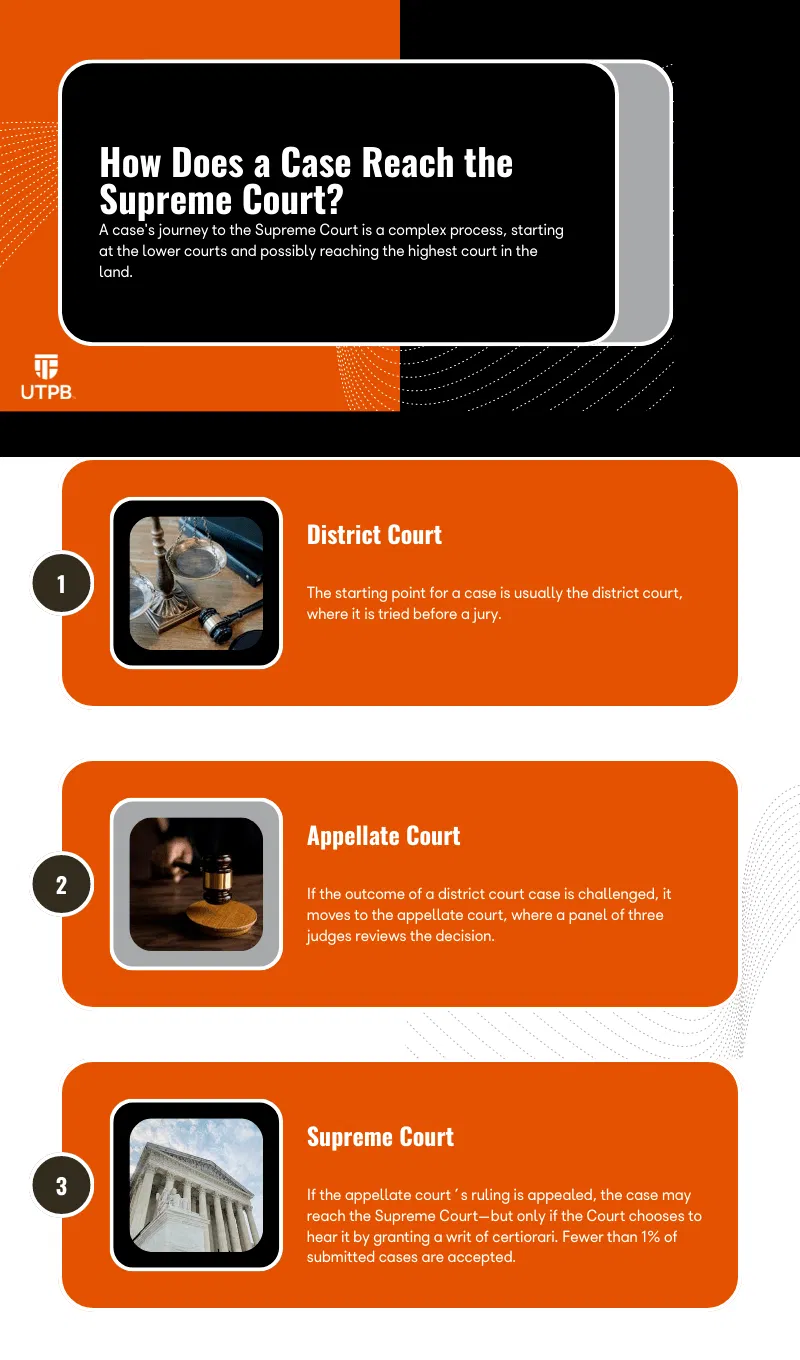
The journey to the Supreme Court is rigorous and selective. Most cases begin in U.S. District Courts, where trials are conducted with judges and juries. If a party disagrees with the outcome, they can appeal to one of the 13 U.S. Courts of Appeals, where three-judge panels review legal arguments without juries. From there, a party seeking Supreme Court review must file a 'writ of certiorari'—a formal request for the Court to hear the case. The Supreme Court receives approximately 10,000 such petitions annually but typically hears only 70 to 80 cases each term. The selection process follows the 'rule of four': at least four of the nine justices must agree that a case has sufficient legal significance to warrant review. This high selectivity means the Court focuses on cases that present important constitutional questions, resolve conflicts between lower courts, or address matters of national significance.
Why the Supreme Court Matters: Key Powers and Limitations
The Supreme Court's most famous power is judicial review—the authority to declare legislative or executive actions unconstitutional. This power, established in the 1803 case Marbury v. Madison, gives the Court the ability to check the other branches of government and protect individual rights. However, the Court also faces significant constraints. Its rulings depend on lower courts and government agencies for implementation, and it cannot initiate cases—it must wait for appropriate disputes to come before it. Additionally, while Supreme Court decisions are final and binding, they can be overturned through two mechanisms: a constitutional amendment (extremely rare) or the Court itself reversing an earlier decision in a new case. This latter process, known as 'stare decisis,' allows the Court to adapt to changing societal values while maintaining legal stability.
The Supreme Court Today: Composition and Current Term
The current Supreme Court consists of nine justices: one Chief Justice and eight Associate Justices. Justices are appointed by the President and confirmed by the Senate, serving lifetime terms to ensure judicial independence. The Court's term begins on the first Monday in October and typically ends in late June or early July. During this period, the justices hear oral arguments, deliberate in private conferences, and issue written opinions that become the law of the land. Recent terms have addressed significant issues including voting rights, environmental regulations, and digital privacy, demonstrating the Court's ongoing relevance in addressing contemporary challenges. The Court's composition and ideological balance continue to be subjects of intense public debate and scholarly analysis.
The Future of the Supreme Court: Ongoing Debates and Potential Reforms
As American society evolves, so too does the conversation about the Supreme Court's structure and practices. Several reform proposals have gained attention in recent years, including term limits for justices (rather than lifetime appointments), expanding the number of justices on the Court, and establishing a formal code of ethics specifically for Supreme Court justices. Supporters argue these changes would modernize the Court and enhance public confidence, while opponents maintain that the current system preserves judicial independence and stability. Regardless of potential reforms, the Supreme Court will continue to face complex questions about technology, civil liberties, federalism, and the balance between individual rights and government authority in the years ahead.
Key Points to Remember About the Supreme Court
- The Supreme Court is the highest court in the United States, with final authority on constitutional interpretation
- Only about 1% of petitions for review are accepted each year, using the 'rule of four' for case selection
- Justices serve lifetime appointments after presidential nomination and Senate confirmation
- The Court's power of judicial review allows it to declare laws and executive actions unconstitutional
- While decisions are binding, they can be overturned by constitutional amendments or the Court itself in later cases
- The Court's annual term runs from October through June, with major decisions often announced in the spring
Understanding how the Supreme Court works provides crucial insight into American democracy itself. From its meticulous case selection process to its landmark rulings that shape society, the Court operates as both a legal institution and a guardian of constitutional principles. Whether you're a student, a concerned citizen, or simply curious about American government, knowing how cases reach the nation's highest court and how justices make their decisions demystifies one of the most important—and often least understood—branches of the U.S. government.