
Bitcoin's price has been a subject of fascination, confusion, and debate since the cryptocurrency first launched in 2009. One day it surges by thousands of dollars, the next it plunges just as dramatically. But unlike traditional stocks or commodities, Bitcoin has no central bank setting its value, no CEO issuing earnings reports, and no government backing its price. So how exactly is the Bitcoin price determined? The answer lies in a combination of basic economics, technological design, and market psychology.
The Core Principle: Supply and Demand
At its most fundamental level, Bitcoin's price is determined by the same force that drives the price of everything else in a free market: supply and demand. When more people want to buy Bitcoin than sell it, the price goes up. When more people want to sell than buy, the price goes down. As River Financial explains, "Bitcoin's price is determined based on supply and demand. Bitcoin has a supply cap where no more than 21 million BTC will ever exist. Bitcoin's price increases when demand exceeds supply and decreases when demand falls."
What makes Bitcoin unique is that its supply is completely inelastic — it doesn't respond to changes in demand like most goods do. When the price of gold rises, miners ramp up production. When the price of a popular new smartphone skyrockets, the manufacturer builds more. But Bitcoin doesn't work that way. Its supply schedule is baked into its code and cannot be changed, no matter how high the price goes or how many people want to buy it.
The 21 Million Cap: Bitcoin's Built-In Scarcity
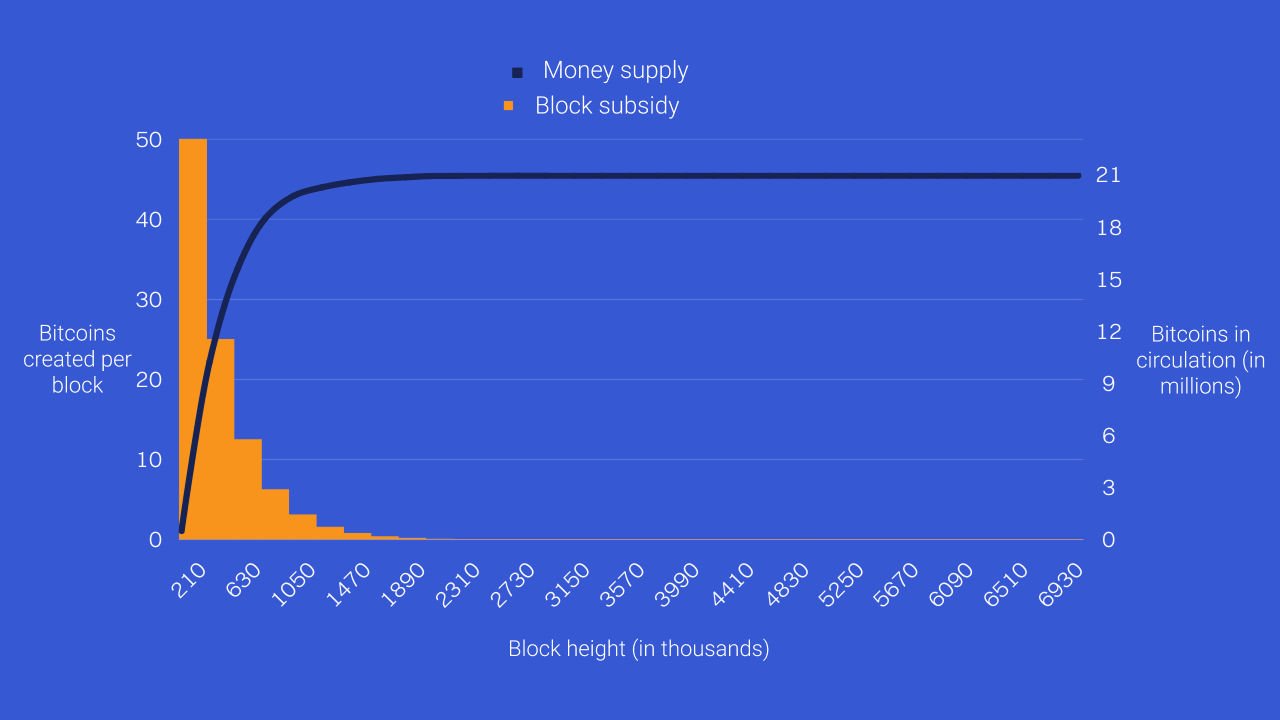
Bitcoin's most important price feature is its hard cap of 21 million coins. No more than 21 million bitcoins will ever exist. This is enforced by the Bitcoin protocol itself, and changing it would require near-universal agreement from the entire network. This fixed supply creates digital scarcity — a property that Bitcoin shares with precious metals like gold but not with fiat currencies, which central banks can print in unlimited quantities.
According to Bitstack's educational resources, "The monetary issuance policy on Bitcoin is defined in advance, maintained by consensus, and limited to a total of 21 million units. Ultimately, the price of Bitcoin will be supported by an unyielding total supply. Unlike state currencies or other financial assets, on Bitcoin, no central authority can unfairly issue more units of account than expected."
This scarcity is a key reason why many investors view Bitcoin as a store of value, often calling it "digital gold." The transparency of the supply schedule gives investors confidence that Bitcoin's value cannot be diluted by unexpected increases in supply, as happens with fiat currencies during periods of quantitative easing.
Timeline: How Bitcoin Supply Evolves Over Time
Bitcoin's supply doesn't appear all at once — it's released gradually through a process called mining. Here's how the supply schedule works:
- 2009 (Genesis): Bitcoin launches. Each new block mined creates 50 BTC. At this stage, Bitcoin has no established market price.
- 2012 (First Halving): Block reward drops from 50 BTC to 25 BTC. Bitcoin's price begins its first major bull run, eventually reaching around $1,100.
- 2016 (Second Halving): Block reward drops to 12.5 BTC. The price enters a multi-year rally, peaking near $20,000 in late 2017.
- 2020 (Third Halving): Block reward drops to 6.25 BTC. Institutional adoption accelerates, and the price reaches a new all-time high above $69,000 in 2021.
- 2024 (Fourth Halving): Block reward drops to 3.125 BTC. New supply entering the market is now 87.5% lower than in 2012.
- ~2140 (Final Block): The last bitcoin is mined. No new bitcoins will ever be created. Miners will earn only transaction fees.
Why the Bitcoin Price Is So Volatile
If you've watched Bitcoin's price for even a few days, you know it can swing 5%, 10%, or even 20% in a single day. This volatility isn't a bug — it's a feature of how Bitcoin's market works, at least at this stage. According to Bitcoin.com's support center, "Bitcoin's price is constantly changing due to the dynamic forces of supply and demand within a global, decentralized market."
Several factors contribute to this volatility. First, Bitcoin's relatively small market cap compared to traditional assets means that large buy or sell orders can move the price significantly. Second, Bitcoin trades 24/7 across hundreds of exchanges worldwide, with no trading halts or circuit breakers. Third, sentiment and news play an outsized role — a single tweet from a prominent figure or a regulatory announcement in a major economy can trigger massive price swings.
River Financial notes that "thanks to a finite supply and a relatively small market cap, the price of Bitcoin is also much more sensitive to changes in demand, resulting in increased price volatility." As the market matures and Bitcoin's market cap grows, many analysts expect this volatility to decrease over time.
Who Actually Sets the Price?
No single person, company, or government sets the price of Bitcoin. Instead, the price emerges from the collective actions of millions of buyers and sellers on exchanges around the world. As Bitstack explains, "Since no institution has control over Bitcoin, the price of its currency can be freely determined by anyone. There is no single indicator that is true for everyone."
In practice, the price you see on any given exchange is determined by the most recent trades executed on that platform. The widely quoted "Bitcoin price" is typically a weighted average of prices across major exchanges, with the weighting based on trading volume. Because arbitrageurs can buy low on one exchange and sell high on another, prices tend to stay relatively consistent across platforms — though they can diverge during periods of extreme volatility or when specific exchanges face technical issues.
Key Factors That Influence Bitcoin Demand
While supply is fixed and predictable, demand is anything but. Multiple factors influence how many people want to buy Bitcoin at any given time:
- Adoption and Utility: As more merchants accept Bitcoin and more people use it for payments or remittances, demand tends to increase. The Lightning Network, which enables fast and cheap Bitcoin transactions, has boosted its usefulness as a medium of exchange.
- Institutional Adoption: When major companies like MicroStrategy, Tesla, or BlackRock invest in or offer Bitcoin products, it signals legitimacy and drives demand from other institutional investors.
- Regulatory Environment: Clear, favorable regulation tends to boost demand by reducing uncertainty. Bans or restrictive regulations can suppress it.
- Macroeconomic Conditions: During periods of high inflation or economic uncertainty, some investors turn to Bitcoin as a hedge, increasing demand.
- Media and Sentiment: News coverage, social media trends, and influential figures can rapidly shift public sentiment and drive buying or selling waves.
- Competition: The emergence of other cryptocurrencies can divert demand away from Bitcoin, although Bitcoin's first-mover advantage and brand recognition give it a strong moat.
Mining Costs as a Price Floor
Bitcoin mining — the process of adding new transactions to the blockchain — requires significant computing power and electricity. Miners compete to solve complex mathematical problems, and the winner earns newly created bitcoins plus transaction fees. According to Investopedia, "the cost of producing bitcoin through mining" is one factor that influences its price.
The economics are straightforward: if the price of Bitcoin falls below the cost of mining it (electricity, hardware, cooling, facilities), miners may be forced to shut down. This reduces the network's security and creates a natural price floor, as the remaining miners will not sell their coins at a loss. However, this floor is not rigid — it shifts as mining technology improves and energy costs change.
Bitcoin vs. Fiat: A Different Kind of Monetary System
Understanding Bitcoin's price also means understanding how it differs from traditional money. Fiat currencies like the US dollar derive their value from government decree and central bank policy. Central banks can create money out of thin air, which is why inflation is a persistent feature of fiat systems. As River Financial points out, "the creation and distribution of fiat currency is potentially infinite and unpredictable."
Bitcoin turns this model on its head. Its supply is not only limited but also entirely predictable. Everyone in the world can see exactly how many bitcoins exist today and exactly how many will exist at any future date. This transparency is unprecedented in monetary history. "This known scarcity and predictability make Bitcoin a compelling option for investors looking to protect their wealth from inflation or monetary debasement," notes River Financial.
Bitcoin is deflationary by design. The finite supply means that if demand grows over time — as it has for most of Bitcoin's existence — the price must rise to balance the equation. This is the opposite of fiat money, where increasing supply tends to erode purchasing power over time.
Where Things Stand Now
As of 2025, Bitcoin's market has matured significantly from its early days. Over 19.5 million bitcoins have already been mined, leaving fewer than 1.5 million to be created over the next century-plus. Institutional investors, publicly traded companies, and even some governments hold Bitcoin on their balance sheets. Regulated Bitcoin exchange-traded products now exist in multiple major markets, making it easier than ever for traditional investors to gain exposure.
The cryptocurrency continues to trade 24 hours a day, seven days a week, across thousands of exchanges worldwide. While the volatility that characterized its early years has moderated somewhat, Bitcoin remains significantly more volatile than major currencies, stock indices, or gold. Analysts at Fidelity and Schwab have noted that Bitcoin's price cycles have historically seen 75% to 85% price corrections, though each cycle has ultimately reached new highs.
What Happens Next: The Road Ahead for Bitcoin Pricing
Looking forward, several developments could reshape how Bitcoin's price is determined. As the block reward continues to shrink through future halvings, the supply of new bitcoins entering the market will dwindle toward zero. By 2032, over 98% of all bitcoins will have been mined. This increasing scarcity could put sustained upward pressure on price if demand continues to grow.
The growing integration of Bitcoin into traditional finance — through ETFs, retirement accounts, and corporate treasuries — may reduce volatility over time by bringing in longer-term, institutional holders. However, the inherently speculative nature of the market and the 24/7 trading cycle mean that some volatility is likely here to stay. Ultimately, with a fixed supply and growing global awareness, the price of Bitcoin will continue to reflect the world's collective assessment of its value as money, technology, and a store of wealth.
Key Takeaways
- Bitcoin's price is determined by supply and demand on global exchanges — no single entity sets it
- The 21 million coin cap creates digital scarcity, and new supply decreases by half every four years through halving events
- Unlike fiat currencies, Bitcoin's supply is completely inelastic and unaffected by demand changes
- Mining costs, regulation, institutional adoption, and market sentiment are major demand-side drivers
- Bitcoin is deflationary by design — its fixed supply means increasing demand naturally pushes prices higher
- While still volatile, Bitcoin's market is maturing with growing institutional participation and regulatory clarity