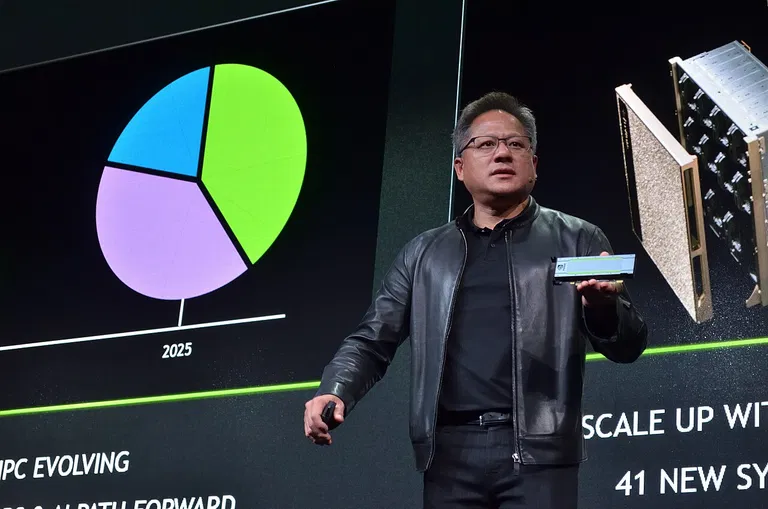
Jensen Huang is the Taiwanese-American co-founder and chief executive officer of Nvidia, the semiconductor company whose graphics processing units — better known as GPUs — became the engines of the artificial intelligence boom. Born Jen-Hsun Huang in Tainan, Taiwan, on February 17, 1963, he has led Nvidia since co-founding it on April 5, 1993, making him one of the longest-serving chief executives in the technology industry. Under his leadership, Nvidia grew from a struggling 3D-graphics startup into a company worth roughly $4.3 trillion that briefly became the first in history to surpass a $5 trillion market valuation. To understand the modern AI era, it helps to understand who Jensen Huang is and how Nvidia's technology actually works.
From a Kentucky boarding school to Silicon Valley
Huang's route to Silicon Valley was shaped by an unusual childhood built on migration and early independence. Born in Tainan, Taiwan, he spent part of his early years in Thailand, where he attended an international school between the ages of five and nine. In 1973, his parents sent him and his older brother to the United States, intending for them to live with an uncle in Tacoma, Washington. As Huang has recounted, the brothers were instead enrolled — reportedly by accident — at Oneida Baptist Institute, a boarding school in rural Kentucky, where Huang was one of very few Asian students. He has described scrubbing bathrooms as part of his chores there, and from 1978 he washed dishes and waited tables at a Denny's in Oregon, experiences he credits with building his resilience and work ethic.
After reuniting with his family in Oregon, Huang studied electrical engineering at Oregon State University, graduating in 1984, and later earned a master's degree in electrical engineering from Stanford University in 1992 while working in the industry. He launched his career at AMD working on microprocessor design, then spent roughly eight years at LSI Logic, a chip manufacturer, where he held senior engineering and marketing roles and rose through the ranks. It was at LSI Logic that he crossed paths with two engineers from Sun Microsystems, Chris Malachowsky and Curtis Priem — the men who would become his co-founders.
Founding Nvidia over breakfast at Denny's
In 1993, Huang, Malachowsky, and Priem met at a Denny's restaurant — the same chain where Huang had once worked — and sketched out a plan for a company devoted to 3D graphics for personal computers and gaming. They founded Nvidia on April 5, 1993, with Huang as president and CEO, a role he has held ever since. The company's core bet was that graphics processing would become a fundamental part of everyday computing rather than a niche add-on, and that a dedicated chip could handle the heavy math of rendering images far better than a general-purpose CPU.
What Nvidia does — and how a GPU actually works
Nvidia designs graphics processing units and the software that runs on them. To grasp why these chips matter, it helps to contrast a GPU with a central processing unit, or CPU, the "brain" of a computer. A CPU has a small number of powerful cores — typically 8 to 16 — built to execute complex, sequential tasks quickly, one after another. A GPU takes the opposite approach: it packs thousands of smaller, simpler cores designed to perform many straightforward calculations at the same time, in parallel.
That parallel architecture made GPUs ideal for rendering graphics, where millions of pixels must be processed simultaneously. But it also made them ideal for artificial intelligence, because training a neural network relies on the same kind of repetitive, parallel math — multiplying enormous grids of numbers over and over. In 1999, Nvidia introduced the GeForce 256, marketed as the world's first GPU, a milestone that placed a dedicated parallel processor for geometry and lighting into consumer graphics cards.
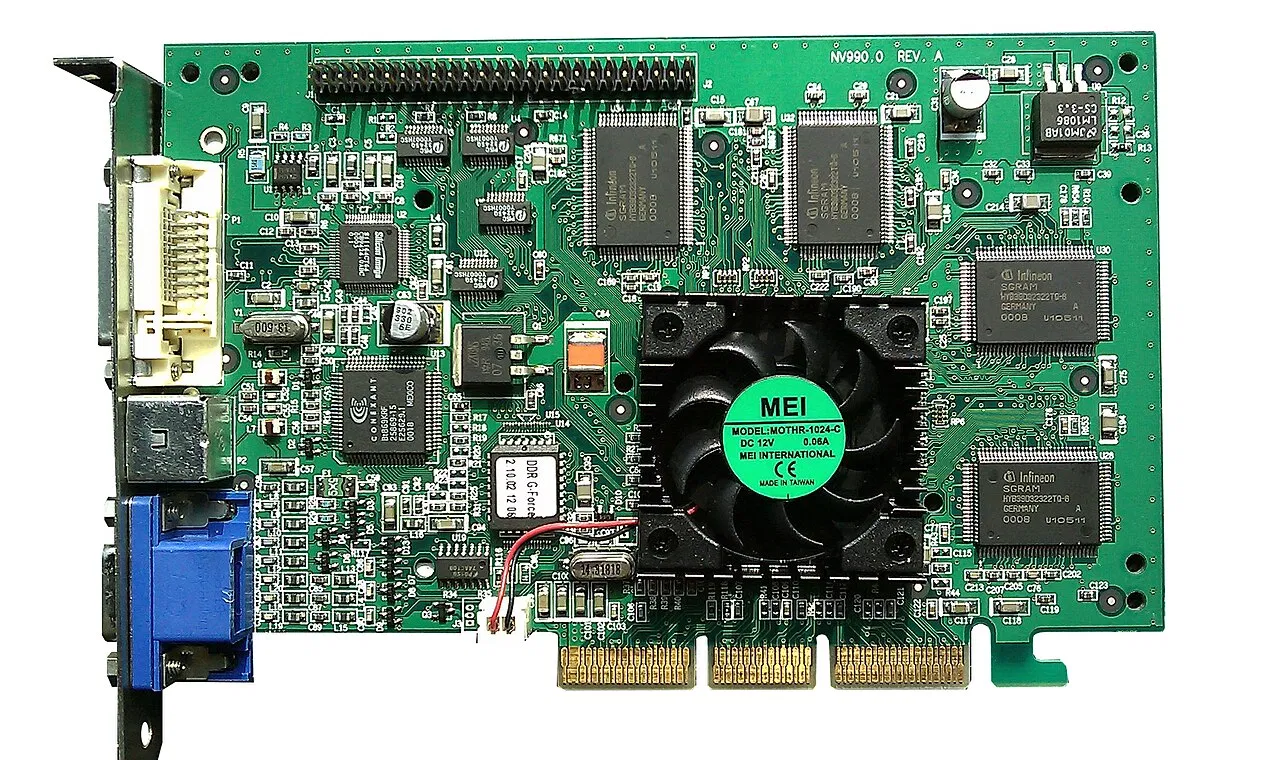
The bigger turning point arrived in 2006, when Nvidia released CUDA, a software platform that let programmers harness a GPU's thousands of cores for general-purpose computing — physics simulations, scientific research, and, eventually, machine learning. Historians and analysts widely credit Huang with betting on CUDA and AI years before the market caught up, pouring billions into the technology through lean years when Wall Street saw Nvidia mainly as a gaming-graphics company.
Nvidia's timeline: from gaming graphics to AI dominance
Nvidia's transformation unfolded over more than three decades. After the GeForce 256 debuted in 1999, the company's GeForce line became a household name in PC gaming. The 2006 launch of CUDA quietly laid groundwork for a much larger market. In the 2010s, researchers discovered that GPUs were dramatically faster than CPUs at training deep-learning models, and Nvidia's data-center chips — the A100, then the H100, and most recently the Blackwell family announced in March 2024 — became the hardware of choice for companies building AI. Blackwell, the successor to the Hopper architecture, delivers roughly five times the performance of its H100 predecessor, according to Nvidia.
The results are visible in the numbers. As of November 2026, Nvidia's market capitalization stood at roughly $4.3 trillion, making it the world's second-most-valuable company, and in October 2025 it became the first company ever to top a $5 trillion valuation. Huang's personal fortune, built almost entirely on Nvidia stock, has been estimated at more than $150 billion.
Why Jensen Huang matters beyond the numbers
Huang is also one of the most recognizable figures in technology, famous for his signature black leather jackets — often designer Tom Ford — which have become something of a uniform at Nvidia's GTC conferences. In July 2026, one of his jackets sold at a Sotheby's auction for about $960,000, with proceeds directed to philanthropy. The look has become shorthand for Huang's "CEO as product" approach and his keynote-driven leadership style.
Beneath the image lies a deeper influence: a conviction that accelerated, parallel computing would redefine computing itself. Huang is widely credited with foreseeing the AI revolution more than a decade before it fully arrived, steering Nvidia toward data centers, robotics, and autonomous systems while much of the industry stayed focused on CPUs and mobile devices.
Where Nvidia and Huang stand today
Today, Nvidia's GPUs power a large share of the world's AI training and inference, from chatbots and image generators to scientific research, and its data-center business has overtaken gaming as the company's largest source of revenue. Demand for its AI chips has been strong enough that supply has at times struggled to keep up, and Nvidia has widened its lead with the Blackwell architecture and its push into complete AI data-center systems, networking, and software. Huang, now in his fourth decade at the helm, remains one of the few founders still running the company he created.
What comes next
Nvidia has signaled that its next architecture, codenamed Rubin, is on the roadmap after Blackwell, and the company continues to expand beyond individual chips into full-stack AI infrastructure. Analysts broadly expect demand for AI computing to keep growing, though the sector also faces questions about energy consumption, competition from custom silicon, and government scrutiny. For Huang, the long-term bet remains the same one he placed in 1993 and doubled down on with CUDA: that parallel computing will keep spreading into every corner of technology.
Key takeaways
- Jensen Huang, born February 17, 1963, in Tainan, Taiwan, is the co-founder and CEO of Nvidia and has led the company since 1993.
- He co-founded Nvidia on April 5, 1993, with Chris Malachowsky and Curtis Priem after conceiving the company over a meal at a Denny's.
- Nvidia designs GPUs — chips with thousands of cores that run many calculations in parallel — which became essential for gaming graphics and, later, for training AI models.
- The GeForce 256 (1999) was marketed as the world's first GPU, and the 2006 CUDA platform unlocked GPUs for general-purpose and scientific computing.
- Nvidia is worth roughly $4.3 trillion as of November 2026 and was the first company in history to exceed a $5 trillion valuation.