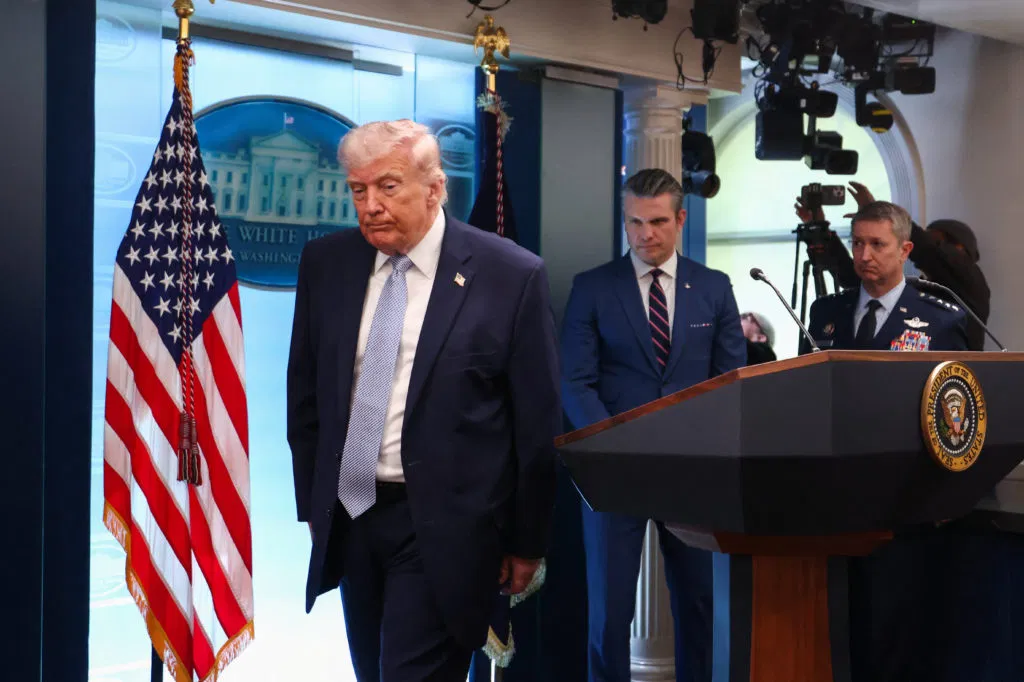
The 25th Amendment to the U.S. Constitution has surged back into headlines after President Donald Trump’s Easter Sunday social media post threatening Iran prompted Democratic lawmakers to call for his removal via this constitutional provision. But what exactly is the 25th Amendment, how does it work, and when has it been used before? Here’s a comprehensive explainer of the amendment that addresses presidential succession and incapacity—and why it’s so difficult to invoke.
How the 25th Amendment Works: The Four Sections Explained
Ratified on February 10, 1967, the 25th Amendment was designed to resolve ambiguities in presidential and vice-presidential succession. The amendment has four key sections that address different scenarios:
Section 1 clarifies that if the president dies, resigns, or is removed from office, the vice president becomes president—not just acting president. This was a direct response to the confusion following President John F. Kennedy’s assassination in 1963.
Section 2 provides a process for filling a vacancy in the vice presidency. The president nominates a new vice president, who must be confirmed by a majority vote of both houses of Congress.
Section 3 allows a president to voluntarily and temporarily transfer power to the vice president by declaring in writing to congressional leaders that they are “unable to discharge the powers and duties” of the office. The president can resume power by submitting another declaration.
Section 4 is the most controversial part—the involuntary removal mechanism. It allows the vice president and a majority of the Cabinet (or another body Congress might create) to declare the president unable to serve. If they do, the vice president immediately becomes acting president. The president can contest this by submitting a declaration of no inability, but if the vice president and Cabinet reaffirm their position within four days, Congress must decide. A two‑thirds vote of both chambers is required to keep the vice president as acting president.
When Has the 25th Amendment Been Used? A History of Invocations
The 25th Amendment has been invoked several times, mostly under Section 3 for planned medical procedures. The first use occurred in 1973 when President Richard Nixon nominated Gerald Ford to fill the vice‑presidential vacancy after Spiro Agnew’s resignation. The most notable uses of Section 3 include:
- 1985: President Ronald Reagan transferred power to Vice President George H.W. Bush for about eight hours during colon‑cancer surgery.
- 2002 and 2007: President George W. Bush temporarily transferred power to Vice President Dick Cheney during colonoscopies.
- 2021: President Joe Biden transferred power to Vice President Kamala Harris for about 85 minutes during a routine colonoscopy.
Section 4—the involuntary provision—has never been fully invoked, though it was considered after the 1981 assassination attempt on Reagan and again after the January 6, 2021, Capitol attack during Trump’s presidency.
Why the 25th Amendment Is So Difficult to Invoke
Legal experts emphasize that the 25th Amendment is not a tool for removing a president over policy disagreements or misconduct. “The 25th Amendment has a limited focus on whether a president is physically or mentally incapable of doing his job,” University of North Carolina law professor Michael J. Gerhardt told PolitiFact. “It is not a remedy for misconduct that the president might have committed.”
The amendment’s language—“unable to discharge the powers and duties of his office”—is intentionally vague to cover unforeseen circumstances, but the drafting history shows it was meant for genuine incapacity, not unpopular decisions. Moreover, the process sets a very high bar: it requires the vice president and a majority of the Cabinet to act against the president, and ultimately a two‑thirds congressional vote. This makes it a political, not just legal, hurdle.
Latest Calls for Invoking the 25th Amendment Against Trump
In April 2026, President Trump’s profanity‑laced Easter Sunday post on Truth Social threatening to bomb civilian infrastructure in Iran sparked renewed calls from Democratic lawmakers to invoke the 25th Amendment. Senator Chris Murphy (D‑Conn.) wrote on X, “If I were in Trump’s Cabinet, I would spend Easter calling constitutional lawyers about the 25th Amendment. This is completely, utterly unhinged.” Other Democrats, including Representatives Yassamin Ansari and Melanie Stansbury, also called for using the amendment.
These calls are not new; Democrats have sought to use the 25th Amendment against Trump since the January 6 Capitol attack. Conversely, Republicans previously called for invoking it against President Biden after special counsel Robert Hur’s 2024 report cited his “poor memory” and after his stumbling June 2024 debate performance.
Despite the rhetoric, invoking the amendment against Trump is considered highly unlikely because Vice President JD Vance, Trump’s Cabinet, and most congressional Republicans strongly support him. The White House dismissed the calls, with spokesperson Davis Ingle saying, “President Trump is working tirelessly on behalf of the American people to fulfill his commonsense America First agenda.”
The Future of Presidential Succession and the 25th Amendment
The 25th Amendment remains a critical safeguard for presidential continuity, but its involuntary removal mechanism is likely to remain a theoretical option rather than a practical tool unless a president experiences clear, prolonged incapacity with bipartisan consensus. The amendment’s drafters, led by Senator Birch Bayh, designed it to be used only in extreme circumstances—not as a political weapon.
As political polarization deepens, discussions about the 25th Amendment will probably continue to surface during moments of crisis or controversy. However, its high thresholds ensure that removing a president against their will would require extraordinary evidence of inability and broad agreement across party lines.
Key Takeaways About the 25th Amendment
- The 25th Amendment was ratified in 1967 to clarify presidential succession and address incapacity.
- It has four sections covering succession, vice‑presidential vacancies, voluntary temporary transfers, and involuntary removal.
- Section 3 has been used multiple times for planned medical procedures; Section 4 has never been fully invoked.
- The amendment is designed for genuine physical or mental incapacity, not policy disagreements or misconduct.
- Recent calls to invoke it against Trump highlight its political sensitivity but are unlikely to succeed due to lack of support from the vice president and Cabinet.
Understanding the 25th Amendment is essential for anyone following American politics. It’s a constitutional safety net that, while rarely used, ensures the presidency can continue functioning even in the most unexpected circumstances.