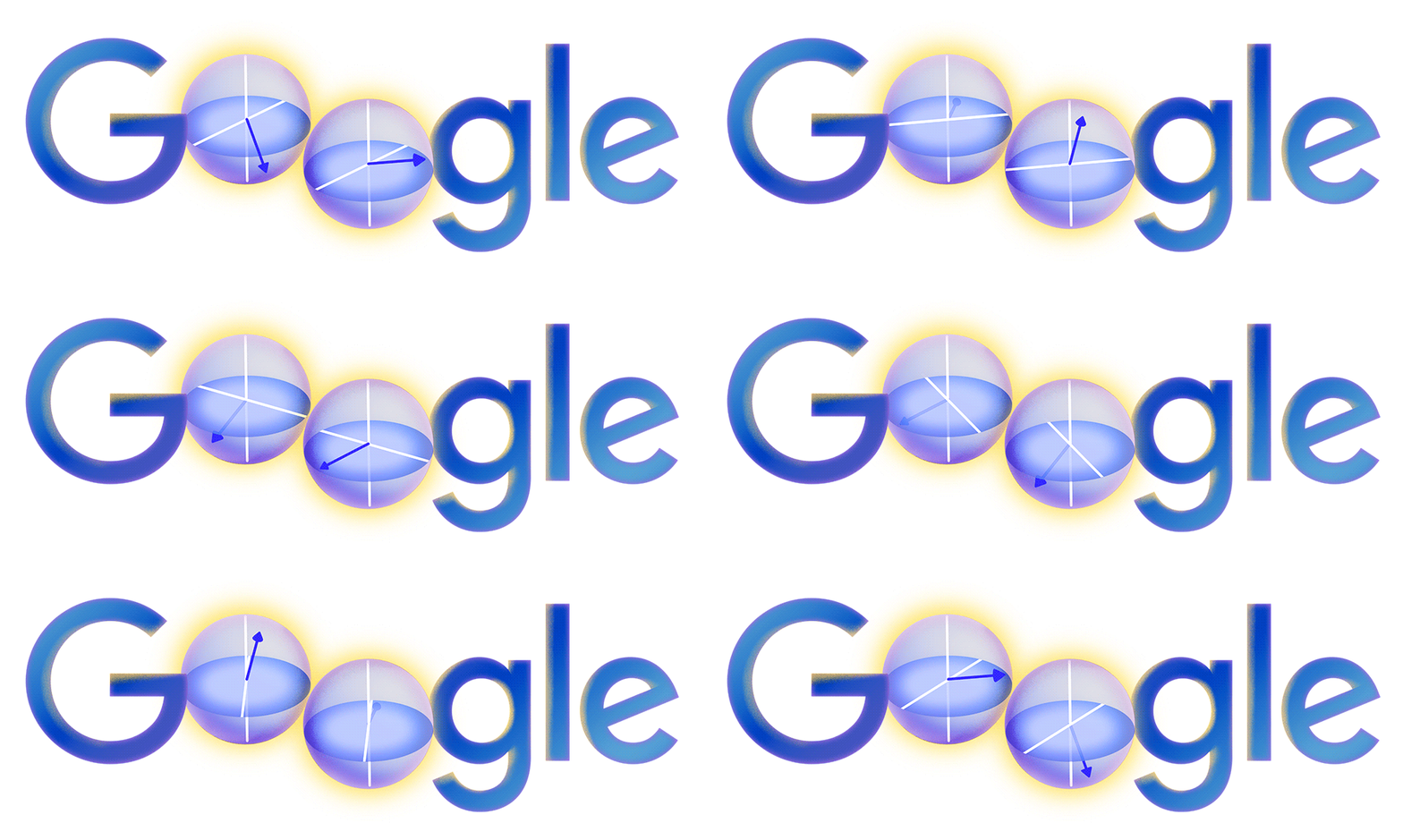
On April 14, 2026, scientists, educators, and technology enthusiasts around the world celebrated World Quantum Day—an annual global event designed to demystify one of science's most complex fields. With Google marking the occasion with a special interactive Doodle and organizations from over 65 countries hosting events, this year's celebration highlighted how quantum science is moving from laboratory curiosity to real-world technology that could reshape computing, communication, and our understanding of reality itself.
What Exactly is World Quantum Day?
World Quantum Day is an international grassroots initiative launched in 2021 by quantum scientists from more than 65 countries. The first global celebration took place on April 14, 2022, making 2026 the fifth annual observance. The day's primary mission is to promote public awareness and understanding of quantum science and technology through accessible educational activities.
According to the official World Quantum Day organization, quantum physics represents "the most fundamental theory we have to describe Nature at the level of the elementary particles and forces that constitute our Universe." The initiative aims to bridge the gap between complex scientific concepts and public understanding, emphasizing how quantum principles already impact daily life through technologies like GPS, medical imaging, and secure communications.
Why April 14? The Planck Constant Connection
The choice of April 14 (4/14) is no accident—it's a direct reference to one of quantum physics' most important numbers. The date corresponds to 4.14, the rounded first three digits of Planck's constant (approximately 4.1356677×10⁻¹⁵ eV·s). This fundamental constant, discovered by physicist Max Planck in 1900, represents the quantum of action in quantum mechanics and serves as a foundational parameter in the mathematical formulations of the field.
Planck's constant defines the relationship between a photon's energy and its frequency, establishing that energy is quantized—meaning it comes in discrete packets rather than continuous flows. This realization marked the birth of quantum theory. Today, the constant is so fundamental that it's used to define the kilogram in the International System of Units (SI), replacing the previous physical artifact standard with a measurement based on this unchanging natural constant.
Understanding Quantum Mechanics: The Basics
Quantum mechanics studies matter and energy at the atomic and subatomic level, where particles behave in ways that defy classical intuition. The U.S. Department of Energy explains that quantum mechanics describes how "extremely small objects simultaneously have the characteristics of both particles and waves." This dual nature leads to several key principles that form the foundation of quantum science:
- Superposition: Quantum particles can exist in multiple states simultaneously until measured, unlike classical bits that are strictly 0 or 1.
- Entanglement: Particles can become linked so that the state of one instantly affects another, regardless of distance—a phenomenon Einstein famously called "spooky action at a distance."
- Quantization: Certain properties, like energy, can only take specific discrete values rather than any value along a continuum.
- Uncertainty Principle: There are fundamental limits to how precisely we can know certain pairs of properties, like position and momentum, simultaneously.
These principles aren't just theoretical curiosities—they're the operating rules for technologies ranging from semiconductor chips and lasers to magnetic resonance imaging (MRI) machines and atomic clocks.
How World Quantum Day is Celebrated
World Quantum Day 2026 featured a diverse array of global activities designed to make quantum concepts accessible to everyone. According to event organizers and news reports, celebrations typically include:
- Educational talks and symposiums: Experts explain quantum concepts in approachable language at universities, schools, and public venues.
- Laboratory tours: Research facilities open their doors to show cutting-edge quantum experiments in action.
- Panel discussions: Scientists, engineers, and ethicists debate the societal implications of quantum technologies.
- Artistic creations: Artists collaborate with scientists to visualize quantum phenomena through various media.
- Online programming: Webinars, virtual lab tours, and interactive demonstrations reach global audiences.
- Google Doodle: For 2026, Google created an animated Doodle featuring the Bloch Sphere—a visual representation of how quantum bits (qubits) work in superposition.
The Quantum Insider reported that 2026 events aimed to "make quantum concepts accessible to non-specialists while highlighting their profound impact on modern society." Activities spanned from professional conferences to hands-on demonstrations suitable for children, reflecting the initiative's commitment to reaching audiences of all ages and backgrounds.
The Impact of Quantum Science on Our Lives
While quantum computers capable of solving currently intractable problems remain in development, quantum principles already underpin many technologies we use daily. As explained by World Quantum Day organizers, "From the fabric of spacetime to the GPS on your phone, the Universe speaks the language of quantum mechanics." Key applications include:
- Global Positioning Systems (GPS): Atomic clocks using quantum principles provide the precise timing needed for satellite navigation.
- Medical Imaging: Magnetic Resonance Imaging (MRI) relies on quantum properties of atomic nuclei to create detailed body scans.
- Semiconductor Technology: Transistors in computers and smartphones operate based on quantum mechanical principles.
- Lasers and Fiber Optics: Quantum theory explains light amplification and transmission through optical fibers.
- Cryptography: Quantum key distribution enables theoretically unbreakable secure communications.
- Materials Science: Quantum simulations help design new materials with tailored properties for energy, medicine, and industry.
Fast Company notes that World Quantum Day matters "more than you think" because quantum technologies "are crucial for our life today, and can lead to future scientific and technological revolutions" with significant societal impacts.
Looking Ahead: The Future of Quantum Technology
World Quantum Day 2026 arrives at a pivotal moment in quantum technology development. Research institutions and companies worldwide are racing to build practical quantum computers that could revolutionize fields like drug discovery, climate modeling, financial optimization, and artificial intelligence. Google's Doodle explanation highlighted how quantum computers harness superposition and entanglement to "solve specific, complex problems that are out of reach for today's supercomputers."
The University of Rhode Island's physics department emphasizes that World Quantum Day 2026 continues "to celebrate the wonders of quantum science" following the International Year of Quantum Science and Technology. The event encourages public engagement with ongoing research that may transform computing, sensing, and simulation capabilities in the coming decades.
Summary and Key Takeaways
World Quantum Day represents a global effort to demystify one of science's most important yet least understood fields. Key points to remember:
- World Quantum Day occurs annually on April 14, a date referencing Planck's constant (4.14×10⁻¹⁵ eV·s).
- Launched in 2021, the initiative involves scientists from over 65 countries promoting public understanding of quantum science.
- Quantum mechanics studies matter and energy at atomic scales, featuring phenomena like superposition and entanglement.
- Celebrations include educational events, lab tours, artistic projects, and online programming worldwide.
- Quantum principles already enable technologies like GPS, MRI, and semiconductors, with quantum computing promising future breakthroughs.
- Google's 2026 Doodle featured the Bloch Sphere to explain quantum bits and their potential for solving complex problems.
As quantum technologies continue advancing from laboratories to practical applications, World Quantum Day serves as both an educational platform and a reminder that understanding these fundamental scientific principles helps society navigate the technological transformations ahead.