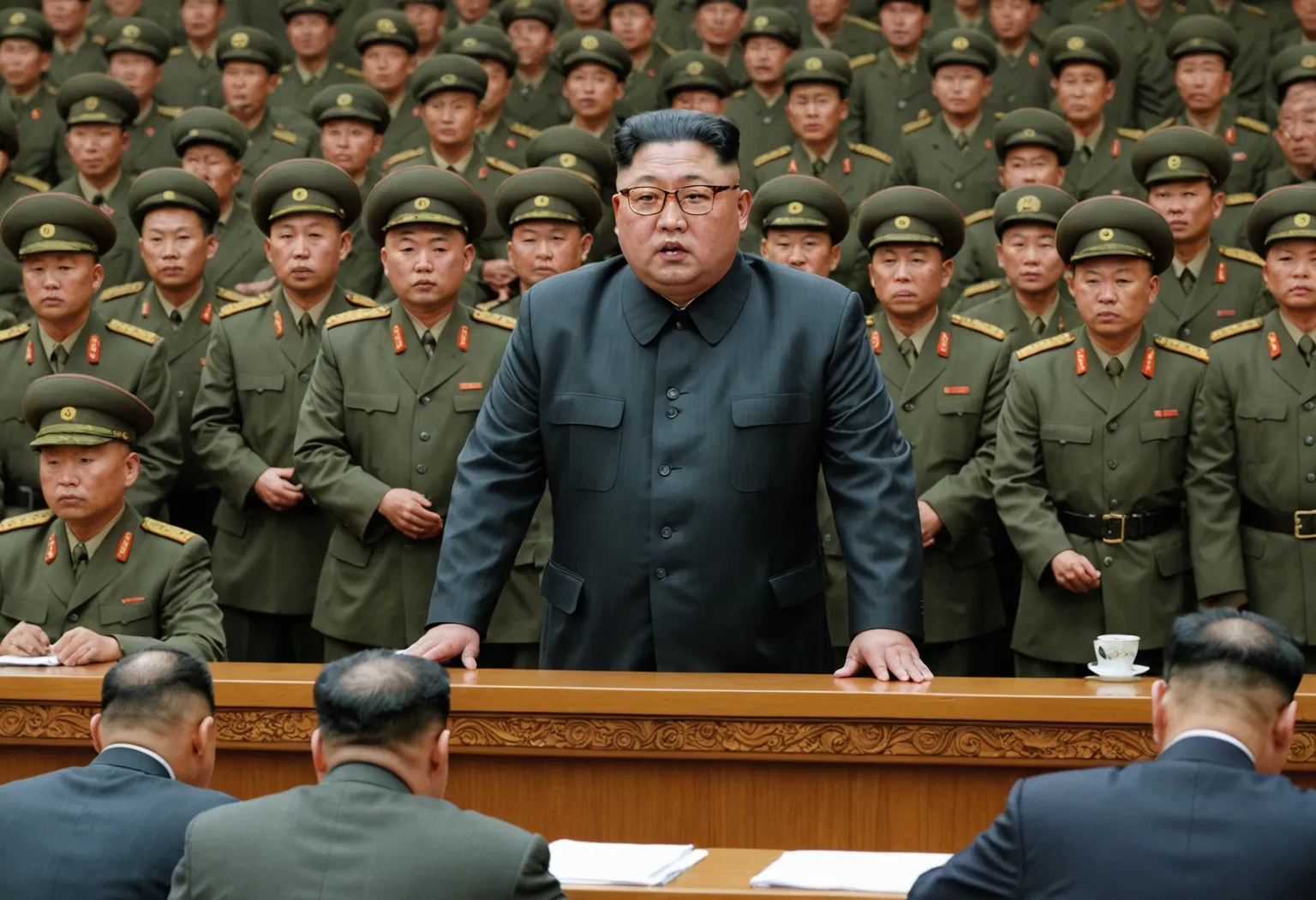
Kim Jong Un is the Supreme Leader of North Korea, the third member of the Kim family to rule the isolated, nuclear-armed country through a hereditary dynasty that has now spanned more than seven decades. Since taking power in December 2011 after the death of his father, Kim Jong Il, he has consolidated absolute control over the state officially known as the Democratic People's Republic of Korea (DPRK) and dramatically accelerated its weapons program. In late October 2026, his name returned to global headlines after unverified online rumors claimed the leader had suffered a brain hemorrhage — claims North Korean state media moved quickly to counter by releasing photographs of him attending a public event in Pyongyang. To understand who Kim Jong Un is, and why his health and possible succession matter to the rest of the world, it helps to know how his family rose to power, how the country's political system actually works, and what his rule has meant for North Korea and beyond.
The Third Kim: How a Hereditary Dynasty Put a Young Man in Charge
Kim Jong Un was born on January 8 — with the exact year still disputed, most often cited as 1982, 1983, or 1984 — in Pyongyang. He is the youngest of Kim Jong Il's three sons and the grandson of Kim Il Sung, the guerrilla-turned-leader who founded North Korea in 1948 and built one of the world's most repressive single-party states. His mother, Ko Yong Hui, was born in Japan to ethnic Korean parents and later worked as a dancer in North Korea; Kim Jong Un rarely discusses her publicly, and state media has largely omitted her from official history.
Unlike his father and grandfather, whose biographies were painstakingly mythologized, much of Kim Jong Un's early life was deliberately kept secret. Western accounts and defector testimony indicate that, as a teenager in the 1990s, he was educated in Switzerland under an assumed identity, attending the International School of Berne and another private school near Bern. He is believed to have later studied at Kim Il Sung University in Pyongyang between 2002 and 2007. This foreign schooling — rare for the tightly controlled ruling family — is often cited by analysts to explain his comparatively open public style.
Despite not being the eldest, Kim Jong Un was chosen as heir. He was first publicly positioned as his father's successor around 2009, and in September 2010 he was given the rank of four-star general and a senior post in the ruling Workers' Party of Korea, signaling the handoff to a new generation. When Kim Jong Il died of a heart attack on December 17, 2011, state television quickly introduced the younger Kim as the 'great successor.' Within days, on December 28, 2011, he was declared the country's supreme leader — reportedly still in his late twenties.
Timeline: From Secret Heir to Absolute Ruler
The speed of Kim Jong Un's rise, and the ruthlessness with which he secured it, is a defining feature of his rule:
- January 8, c. 1982–1984: Kim Jong Un is born in Pyongyang, the youngest of Kim Jong Il's three sons.
- 1990s: He attends private schools in Switzerland under a false name.
- 2009–2010: He is unveiled as successor and promoted to four-star general.
- December 17, 2011: Kim Jong Il dies; state media anoints Kim Jong Un as the 'great successor.'
- December 28, 2011: He is declared supreme leader.
- December 2013: His uncle and former mentor Jang Song Thaek is purged and executed for 'treachery.'
- February 2017: His estranged half-brother Kim Jong Nam is assassinated in Malaysia with a nerve agent.
- June 12, 2018: He meets U.S. President Donald Trump in Singapore, the first summit between a sitting U.S. president and a North Korean leader.
- November 2022: His daughter Kim Ju Ae makes her first public appearance, fueling succession speculation.
How North Korea's Political System Works: Juche and Total Control
North Korea is not a typical dictatorship: it is a hereditary, dynastic one organized around a state ideology called Juche, a Korean word usually translated as 'self-reliance.' Developed under Kim Il Sung and deepened by his successors, Juche combines nationalism with an extreme cult of personality that elevates the ruling Kim family to near-divine status. Scholars note that Juche's real function is less a coherent philosophy than a justification for one-man, one-family rule.
The Workers' Party of Korea (WPK) is the only meaningful political institution, and state media, the military, and the economy ultimately answer to the Supreme Leader. Kim Jong Un holds a collection of overlapping titles — including General Secretary of the WPK and Chairman of the State Affairs Commission — that concentrate military, party, and government authority in a single person. Information is tightly controlled; independent media, political opposition, and free movement are prohibited, and the country consistently ranks among the most closed societies on Earth.
Under Kim Jong Un, the regime has pressed ahead with its nuclear and missile programs, which he has described as essential to the country's survival. According to the Council on Foreign Relations, he has conducted more missile and nuclear tests since taking power than his father and grandfather combined. A sixth and largest nuclear test in September 2017 triggered fresh United Nations sanctions, yet the program has continued to expand, making North Korea a de facto nuclear power and a central concern for the United States, South Korea, and China.
Diplomatically, Kim made history in 2018 by becoming the first North Korean leader to meet a sitting U.S. president, signing a joint statement with Donald Trump in Singapore that pledged to work toward denuclearization of the Korean Peninsula. But a follow-up summit in Hanoi in February 2019 collapsed without a deal, and negotiations have remained largely stalled since, with North Korea continuing to test missiles and modernize its arsenal.
Where Things Stand Now: Death Rumors and the Succession Question
In late October 2026, speculation about Kim Jong Un's health — a recurring feature of his time in power — flared again after unverified social media posts claimed he had suffered a brain hemorrhage. North Korean state media responded by publishing photographs said to show him touring a clothing and footwear exhibition in Pyongyang on October 19, an apparent effort to project normalcy. Outside experts caution that such photos are difficult to independently verify and that rumors about the leader's health have been wrong before.
The episode renewed attention on the question of who would succeed him. Kim's wife is Ri Sol Ju, and the couple's daughter, Kim Ju Ae — believed to be around 12 or 13 years old — has appeared frequently beside her father at military and state events since November 2022. In 2026, South Korea's National Intelligence Service signaled that it now views the teenage daughter as the likely heir, and separately raised the possibility that Kim Jong Un has another, younger child. If confirmed, this would mark the first time a woman, and a fourth generation of the Kim family, has been groomed to lead North Korea.
What Comes Next: The Uncertain Road Ahead
Because North Korea is so closed, analysts are forced to read between the lines of state propaganda, satellite imagery, and intelligence leaks. Most observers expect the regime to continue prioritizing its nuclear deterrent regardless of who leads next, viewing it as the ultimate guarantee against outside intervention. The bigger unknown is whether a potential transition — especially one involving a young, untested successor — could destabilize the careful balance among the military, the Workers' Party, and the Kim family's inner circle.
For the rest of the world, the stakes are high. North Korea's weapons program, its record of human-rights abuses, and its role as a flashpoint between the United States and China mean that any change at the top — real or rumored — is watched closely. For now, Kim Jong Un remains the man in charge of one of the planet's most secretive and heavily armed states.
Key Takeaways: Understanding Kim Jong Un
- Kim Jong Un has ruled North Korea since December 2011, the third generation of the Kim dynasty after his grandfather Kim Il Sung and father Kim Jong Il.
- He was born on January 8 (year disputed, roughly 1982–1984) and was educated partly in Switzerland under a false identity.
- He secured power quickly, purging rivals including his own uncle Jang Song Thaek and allegedly ordering the 2017 killing of his half-brother Kim Jong Nam.
- North Korea is governed through the Juche ideology and the Workers' Party, with nearly all power concentrated in the Supreme Leader.
- Under Kim, North Korea has accelerated its nuclear and missile programs and met with Donald Trump in 2018, but denuclearization talks stalled.
- Recent health rumors and the emergence of his daughter Kim Ju Ae have intensified questions about who might eventually succeed him.