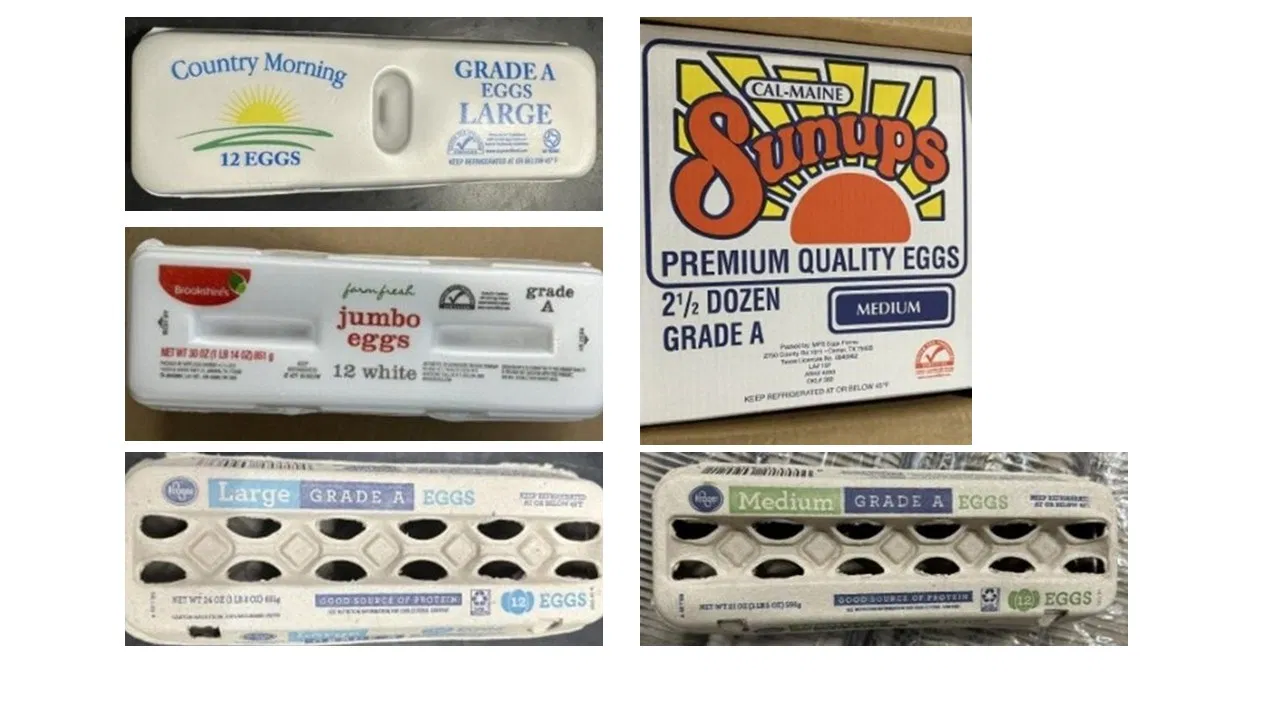
The U.S. Food and Drug Administration (FDA) has escalated a sweeping egg recall to Class I, its most severe risk level, after a multistate Salmonella outbreak linked to the eggs grew to 98 confirmed illnesses and 26 hospitalizations across 17 states. At the center of the recall is Midwest Poultry Services, L.P., which on July 22, 2026 voluntarily pulled more than 1.59 million dozen shell eggs, roughly 19 million individual eggs, produced at two farms in Texas. The August 12 upgrade to Class I signals that federal regulators now believe the recalled eggs carry a reasonable probability of causing serious adverse health consequences or death.
The recall applies to white shell eggs and brown cage-free shell eggs sold in retail and bulk cartons of 6, 12, 18, 24, 30, 36, and 60 eggs. The affected cartons were produced between June 6 and July 3, 2026, and carry sell-by or best-by dates between July 20 and August 17, 2026. They shipped to foodservice and retail customers in Texas, Oklahoma, and Louisiana, reaching shoppers through Kroger stores in Texas and Louisiana, Brookshire Grocery stores across Texas, Oklahoma, Arkansas, Louisiana, New Mexico, and Mississippi, and smaller retail and foodservice outlets.
Inside the Recall: 19 Million Eggs Across Multiple Brands
The recalled eggs were sold under several familiar labels, including Kroger, Simple Truth, Brookshire's, Cal-Maine, and Country Morning, with some cartons also carrying the Sunups brand. Critically, not every carton from these brands is affected. The FDA and CDC say only cartons bearing the plant codes P-1950 or 0840962 with a Julian date between 157 and 184 printed on the side are part of the recall.
Midwest Poultry Services said it identified the potential contamination through proactive environmental monitoring practices and root cause analysis at its two Texas farms. Although the company has said it is not aware of any specific illnesses tied to its products, the CDC's investigation tells a different story. Of the 44 people interviewed about what they ate, 40, or 91%, reported eating shell eggs before getting sick.
If your carton matches, do not eat the eggs. Throw them away or return them to the store for a full refund. Wash any surfaces, containers, or utensils that may have touched the eggs with hot, soapy water, and wash your hands after handling. Consumers with questions can contact Midwest Poultry Services at 574-405-9531 or email [email protected].
Most people with Salmonella develop diarrhea, fever, and stomach cramps within six hours to six days of exposure, and symptoms usually last four to seven days. Young children, adults 65 and older, and people with weakened immune systems are at the highest risk of severe illness. Seek medical care right away if you have diarrhea with a fever higher than 102 degrees Fahrenheit, diarrhea lasting more than two days, bloody diarrhea, or signs of dehydration such as dizziness when standing up.
The Bottom Line
Here are the key points to remember:
- Midwest Poultry Services, L.P. recalled about 19 million shell eggs produced at two Texas farms.
- The FDA elevated the recall to Class I on August 12, 2026, its most severe classification.
- The outbreak has caused 98 illnesses and 26 hospitalizations across 17 states, with no deaths reported.
- Only cartons with codes P-1950 or 0840962 and a Julian date of 157 to 184 are recalled.
- If you have matching eggs, throw them out or return them, and sanitize any surfaces they touched.