Within the span of four days in August 2026, two separate pet food companies pulled products from store shelves: Fromm Family Foods over potential metal contamination in its canned dog food, and Oma's Pride over Salmonella found in a frozen raw food. The two recalls involve different companies, different products, and different hazards, but they both followed the same regulatory process that governs nearly every pet food recall in the United States. Understanding how that system works — and what to do if a can or bag in your own pantry is ever flagged — is the best protection you can give your dog.
Two Recalls, Two Hazards: What Was Pulled Off Shelves
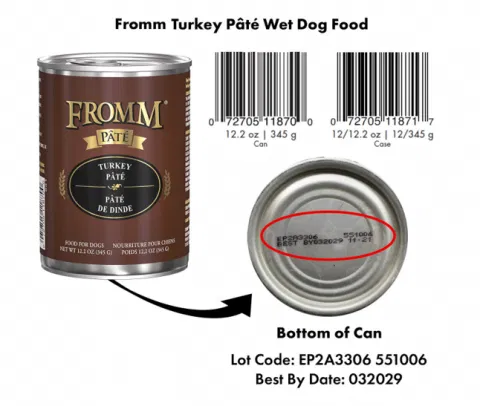
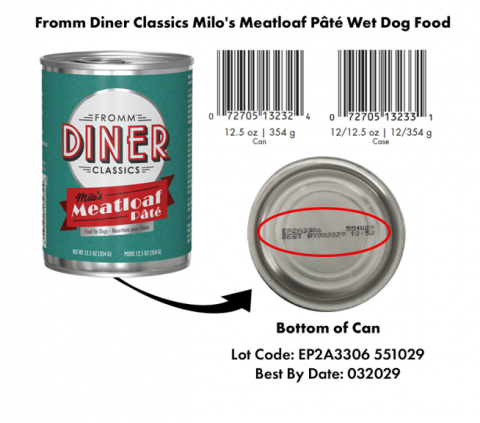
On August 21, 2026, Fromm Family Foods of Mequon, Wisconsin announced it was voluntarily recalling 5,825 total cases of wet canned dog food. The recall covers 3,852 cases of Fromm Turkey Pâté (12.2-ounce cans, UPC 072705118700) and 1,973 cases of Fromm Diner Classics Milo's Meatloaf Pâté (12.5-ounce cans, UPC 072705132324), all carrying a best-by date of 032029. The company said the products may be contaminated with metal. The recalled food was distributed through neighborhood pet stores and online outlets in both the United States and Canada.
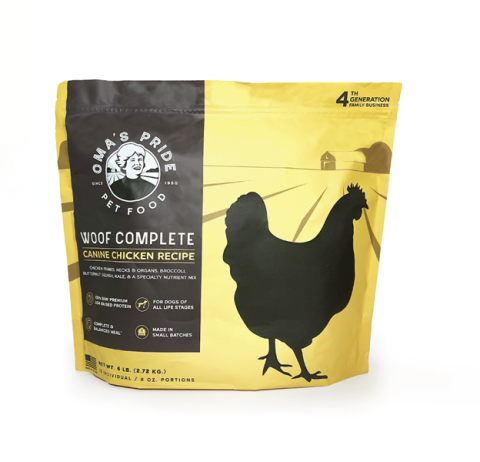
Four days earlier, on August 17, Oma's Pride of Avon, Connecticut recalled a single production lot of its Woof Complete Canine Chicken Recipe, a frozen raw dog food sold in 6-pound bags. The recall covers 639 bags from lot BB012729 (SKU F-WOOFC-6, UPC 8 7938400145 9), manufactured on January 27, 2026, with a best-by date of January 27, 2029. The Food and Drug Administration said a sample of the product tested positive for Salmonella after the agency received a consumer complaint. The affected bags were distributed in Arizona, California, Indiana, Kentucky, Louisiana, Maryland, New Jersey, Nevada, New York, Pennsylvania, and Virginia, both to retail and wholesale accounts and directly to consumers through online orders.
How a Pet Food Recall Actually Works
The FDA regulates pet food sold in the United States and defines a recall as an action taken by a firm to remove a product from the market. A recall can begin three ways: on a company's own initiative, at the FDA's request, or by FDA order under statutory authority. Both the Fromm and Oma's Pride actions were voluntary — started by the companies themselves — which is the most common type of recall by far.
The FDA also sorts recalls into three classes based on risk. Class I recalls involve a reasonable probability that use of or exposure to a product will cause serious health consequences or death. Class II recalls cover products that may cause temporary or medically reversible health problems, or where the probability of serious harm is remote. Class III recalls involve products unlikely to cause adverse health consequences but that still violate the law or regulations. Whenever a company announces a recall, market withdrawal, or safety alert, the FDA posts the company's announcement as a public service — but the agency does not endorse the product or the company.
Pet food recalls are far from rare. The FDA's animal and veterinary recall log lists several recalls during the summer of 2026 alone, including Pedigree wet dog food pulled for potential plastic contamination in July and Adequan canine injections recalled over glass fibers in August. Most recalls are caught through one of two routes: a company's own quality-control testing, or consumer complaints and follow-up testing by regulators — the exact paths that triggered both of this month's recalls.
What Causes Metal and Salmonella Contamination?
Fromm said its recall was launched after the company received complaints of metal contamination, and that it identified the error and put corrective actions in place on top of its existing safety processes. Metal can slip into pet food when manufacturing equipment breaks down or wears — a blade, screen, or machine part can shed fragments into a batch. Even tiny pieces are hazardous. According to Fromm's notice, metal of any size can lacerate a dog's mouth and digestive tract, and larger amounts can lead to stomach upset, partial blockage, and a risk of intestinal obstruction.
Salmonella, by contrast, is a biological hazard rather than a physical one. The bacteria can live in raw meat and poultry, which is why raw diets carry a higher contamination risk. Oma's Pride said the recalled lot tested positive after the FDA collected and analyzed a sample, and the company — a fourth-generation family business with more than 75 years of food manufacturing experience — is continuing its investigation to determine the source. One detail makes Salmonella especially serious: it is zoonotic, meaning it can pass between animals and people. Humans who handle contaminated food without thoroughly washing their hands can develop nausea, vomiting, diarrhea or bloody diarrhea, abdominal cramping, and fever.
What to Do If Your Dog's Food Is Recalled
If you think you may have bought a recalled product, check the details rather than the brand name alone. Recalls almost never cover an entire product line — they are usually limited to specific lot codes, UPC numbers, and best-by dates. For Fromm, that means cans stamped with lot codes EP2A3306 551006 or EP2A3306 551029 and a best-by of 032029. For Oma's Pride, it means a 6-pound bag of Woof Complete Canine Chicken Recipe carrying lot BB012729.
If your food matches, stop feeding it immediately. Fromm asks customers to return the product to the retailer where it was purchased, while Oma's Pride advises disposing of the food safely and contacting the company for a refund. Never sell or donate recalled food. Because Salmonella can spread from food to surfaces, wash and sanitize bowls, cups, storage containers, and your hands after handling the product or any utensils that touched it.
Keep an eye on your dog for symptoms. Metal ingestion can appear as choking, vomiting, loss of appetite, lethargy, or stomach discomfort. A Salmonella infection in pets may look like lethargy, diarrhea — sometimes bloody — fever, vomiting, or reduced appetite, while some dogs show only decreased appetite, fever, and abdominal pain. If your dog ate a recalled product and shows any of these signs, contact your veterinarian right away.
Where Things Stand Now
As of late August 2026, neither company has reported a formal close to its recall, but both have stressed limited scope. Fromm said no other products are affected and that there have been no reports of illness or injury related to the recalled cans. Oma's Pride reported three illnesses in dogs tied to the complaint and clarified that no human illnesses have been reported to date. Both firms are coordinating with the FDA and have posted consumer hotlines: Fromm at 1-800-325-6331 and Oma's Pride at 1-800-678-OMAS.
The Bottom Line: Key Takeaways
- Fromm recalled 5,825 cases of canned dog food (Turkey Pâté and Milo's Meatloaf) over potential metal contamination on August 21, 2026.
- Oma's Pride recalled one lot of Woof Complete Canine Chicken Recipe raw food — 639 bags — over Salmonella on August 17, 2026.
- Most recalls are voluntary and are classified by the FDA as Class I, II, or III based on the level of health risk.
- Always match lot codes, UPCs, and best-by dates before assuming your food is affected.
- Stop feeding, return or safely dispose of the food, sanitize surfaces, and call your veterinarian if symptoms appear.