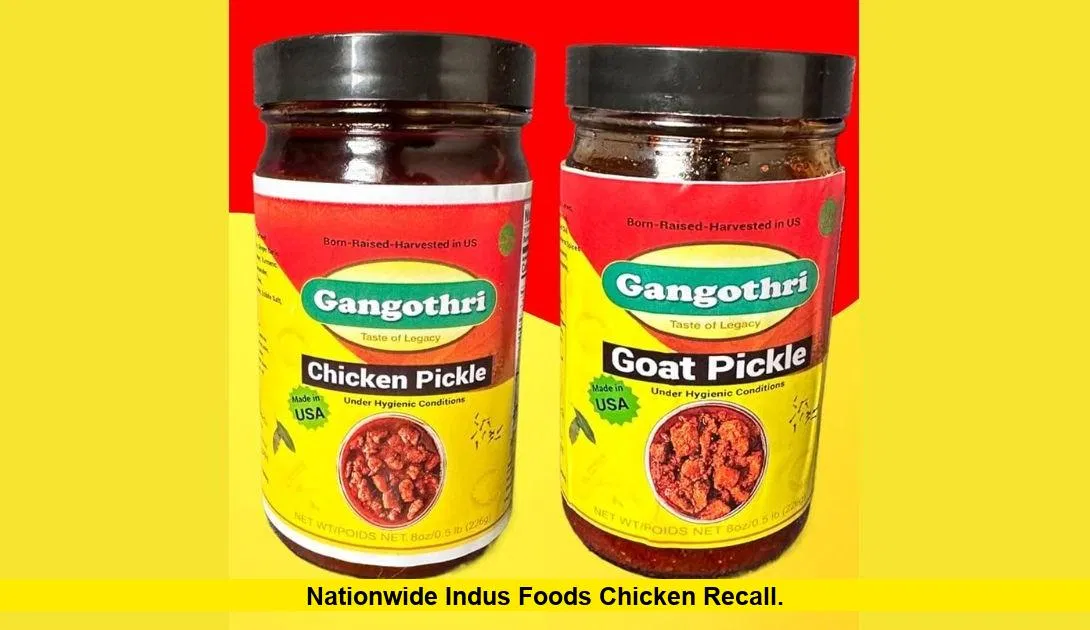
The nationwide Indus Foods chicken recall has pulled roughly 1,626 pounds of ready-to-eat pickled goat and chicken products out of restaurant kitchens, retail shelves, and home pantries across the United States. Indus Foods, LLC — the Austin, Texas company that does business as Gangothri Foods — launched the voluntary recall on August 17, 2026, after the U.S. Department of Agriculture's Food Safety and Inspection Service (FSIS) discovered the jars had been produced without the benefit of federal inspection. Because none of the products bear a USDA mark of inspection, FSIS assigned the recall its most serious classification, Class I, which means there is a reasonable probability the food could cause serious, adverse health consequences or even death. No illnesses have been confirmed so far, but the agency is urging consumers to throw the jars away or return them rather than eat them.
This recall matters beyond a single brand. It is a window into how the United States food-safety system catches problems, why an inspection mark on a label matters, and what ordinary shoppers should do when a chicken product lands on a recall list.
Why Gangothri Foods' Pickled Chicken Jars Are Being Pulled
The recall covers four varieties of ready-to-eat pickles packed in 8-ounce glass jars and sold under the Gangothri Foods name:
- Gangothri Goat Pickle
- Gangothri Gongura Goat Pickle
- Gangothri Chicken Pickle
- Gangothri Gongura Chicken Pickle
According to the FSIS announcement, the jars were produced between January 28, 2025, and May 6, 2026, and carry a two-year shelf life. That long shelf life is significant: even though production stopped in early May 2026, unopened jars may still be sitting in pantries, on distributor shelves, or in restaurant stockrooms well into the future. FSIS said the products were distributed nationwide to restaurants, retail locations, and distributors, and were also sold directly to consumers online.
The defining problem is not a bacteria such as salmonella or listeria. It is procedural: the products were produced without the benefit of inspection, meaning they were made outside the federal inspection system that verifies meat and poultry products are safe, wholesome, and properly labeled. As a result, the jars do not carry the USDA mark of inspection that shoppers normally see on packaged meat and poultry.
How the Indus Foods Recall Unfolded
Food recalls rarely begin with a customer complaint. In this case, FSIS says the problem was discovered during routine surveillance activities — the ongoing monitoring the agency uses to spot products that enter the marketplace without proper oversight. That discovery triggered a series of steps that moved quickly:
- Production window: January 28, 2025, through May 6, 2026.
- Discovery: FSIS surveillance identifies ready-to-eat pickled goat and chicken products made without inspection.
- August 17, 2026: FSIS issues public notice of Recall 017-2026 and classifies it as Class I, high risk.
- Status: The recall remains active, with no confirmed reports of illness.
The speed of the announcement reflects how seriously FSIS treats products that bypass inspection. Because the agency could not verify the safety of the products, it did not wait for a confirmed illness to act.
What Produced Without Benefit of Inspection Actually Means
To understand this recall, it helps to know who regulates what. In the United States, two agencies split food-safety duties. The FSIS, part of the USDA, oversees meat, poultry, and processed egg products. The Food and Drug Administration (FDA), part of the Department of Health and Human Services, regulates nearly all other foods. When a facility produces meat or poultry products for sale, it is supposed to operate under FSIS inspection, and finished packages carry a USDA mark of inspection as proof.
Produced without the benefit of inspection means the products were made outside that supervised system. In practical terms, FSIS could not confirm the facility, ingredients, handling, or labeling met federal safety standards. That uncertainty is why the recall is Class I rather than a lower tier.
FSIS classifies recalls by the level of health risk:
- Class I (high or medium risk): A reasonable probability that using the product will cause serious, adverse health consequences or death.
- Class II (low risk): A remote probability of adverse health consequences.
- Class III (marginal risk): Using the product will not cause adverse health consequences, or the risk is negligible.
Before a recall becomes public, FSIS convenes an Event Assessment Committee to weigh the evidence and decide whether a recall is warranted — and, if so, how to classify it. For Class I and Class II recalls, the agency issues public press releases so consumers and retailers can act quickly. It also runs recall effectiveness checks afterward to confirm the company is actually notifying its customers and removing the product from the market.
What Usually Triggers a Chicken Recall
Not every chicken recall looks like this one. Across the thousands of recalls FSIS has overseen, a handful of causes account for most poultry actions:
- Pathogen contamination: Bacteria such as Salmonella, Listeria monocytogenes, and Campylobacter are common reasons raw and ready-to-eat chicken is recalled. Listeria is especially concerning in ready-to-eat foods because it can grow even under refrigeration.
- Foreign material: Metal fragments, plastic, or other objects can enter products during processing, prompting recalls when discovered.
- Undeclared allergens: Breaded or marinated chicken that contains undeclared milk, soy, wheat, or other allergens is a frequent trigger.
- Mislabeling: Wrong labels, missing ingredient statements, or incorrect use-by dates can all prompt an action.
- Processing and inspection failures: Products made without inspection, undercooked, or handled at unsafe temperatures fall into this category — which is exactly what happened in the Indus Foods case.
Where the Recall Stands Today
As of now, the recall is active and classified as Class I. FSIS reported no confirmed illnesses linked to the products, but the agency warned that some jars may still be in consumers' pantries or on restaurant and distributor shelves. The company contact for the recall is Jyothi Yerramreddy, reachable at 512-284-7790 or [email protected].
Consumers with food-safety questions can call the USDA Meat and Poultry Hotline at 888-MPHotline (888-674-6854) or email [email protected]. Anyone who needs to report a problem with a meat, poultry, or egg product can use the agency's online Electronic Consumer Complaint Monitoring System.
What to Do If You Have Gangothri Pickle Jars at Home
If you bought any of the recalled Gangothri Foods jars — goat pickle, gongura goat pickle, chicken pickle, or gongura chicken pickle — the guidance is straightforward:
- Do not eat it. FSIS urges consumers not to consume the products.
- Throw it away or return it. The products should be discarded or returned to the place of purchase.
- Watch for symptoms. Anyone concerned about a reaction should contact a healthcare provider.
- Check the label. The recalled jars do not bear a USDA mark of inspection, which is the quickest way to spot them.
Food-safety experts also recommend a simple habit after any recall: check your pantry and refrigerator for the specific products, note the brand and package size, and compare them against the recall notice. If in doubt, the safest choice is to throw the item out.
The Bottom Line: Chicken Recall Facts at a Glance
- Who: Indus Foods, LLC, doing business as Gangothri Foods, Austin, Texas.
- What: About 1,626 pounds of ready-to-eat pickled goat and chicken products.
- Why: Produced without the benefit of federal inspection, with no USDA mark of inspection.
- Products: Four 8-ounce glass jar varieties, including Gangothri Chicken Pickle and Gangothri Gongura Chicken Pickle.
- Risk level: Class I, the highest recall classification.
- Illnesses: None reported as of the announcement.
- Action: Do not consume; throw away or return the jars.
The Indus Foods recall is a reminder that food safety is not only about spotting contamination — it is also about verifying that products were made inside a system designed to prevent problems in the first place. When a jar lacks that verification, the safest call is the same one the USDA recommends: don't eat it.