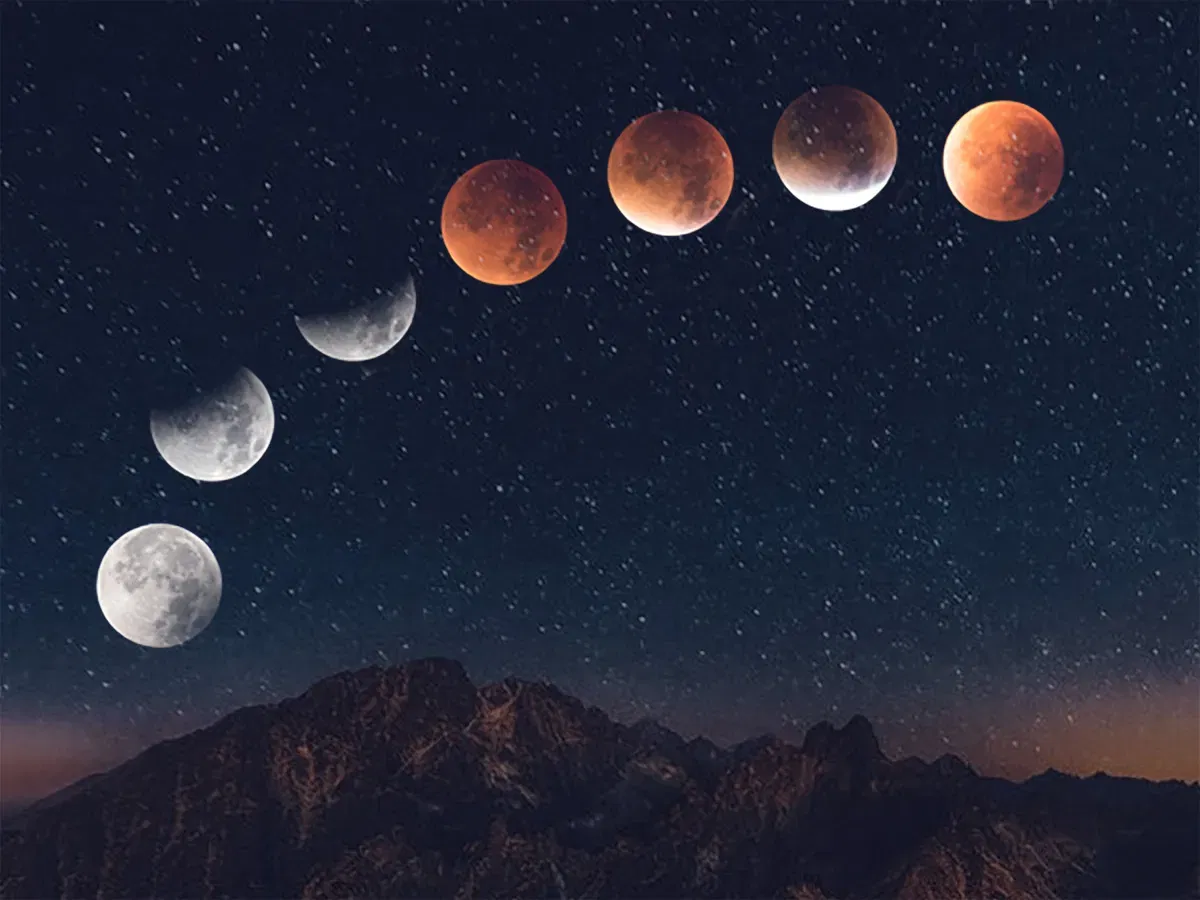
On August 28, 2026, the Moon will slide almost completely into Earth's shadow, treating millions of skywatchers across the Americas to a deep partial lunar eclipse. During this event, Earth's dark inner shadow — the umbra — will cover more than 93 percent of the Moon's diameter, leaving only a thin sliver of the lunar disk in sunlight. It is the final chapter in a remarkable series of lunar eclipses, and unlike a solar eclipse, no special equipment is needed to watch it safely.
A lunar eclipse occurs when the Sun, Earth, and Moon line up so that the Moon passes into Earth's shadow. According to NASA, during a lunar eclipse, Earth's shadow obscures the Moon, darkening it for anyone on the night side of the planet. Like every lunar eclipse, this one happens at full moon — the August 2026 full moon — when the Sun and Moon sit on opposite sides of Earth. The August 2026 event is what astronomers call a partial eclipse, because the Moon never quite makes it fully inside the umbra — but at 93 percent coverage, it comes extremely close to totality.
What Exactly Is the August 2026 Lunar Eclipse?
The eclipse takes place on Friday, August 28, 2026, with the Moon at its ascending node of orbit. Its umbral magnitude of 0.9319 means that 93.19 percent of the Moon's diameter will pass inside Earth's dark umbral shadow at the peak of the event. Because the Moon reaches apogee — its farthest point from Earth — just six days earlier on August 22, its apparent size will be slightly smaller than average, making the eclipse's geometry especially precise.
This partial eclipse belongs to Saros cycle 138 and is the 29th of 82 eclipses in that series. It also stands as the last event of an "almost tetrad": a run of nearly four total lunar eclipses that began in 2025. The three preceding eclipses — on March 14, 2025, September 8, 2025, and March 3, 2026 — were all total. Only this August eclipse falls just short of totality, snapping the streak at three.
How a Lunar Eclipse Works: Earth's Shadow Explains It All
To understand what's happening on August 28, it helps to picture Earth casting a shadow into space. That shadow has two parts: the penumbra, a faint outer region where Earth only partially blocks the Sun, and the umbra, a darker central cone where the Sun's light is completely blocked. During a lunar eclipse, the Moon travels through this shadow, and how much of it enters the umbra determines whether the eclipse is partial or total.
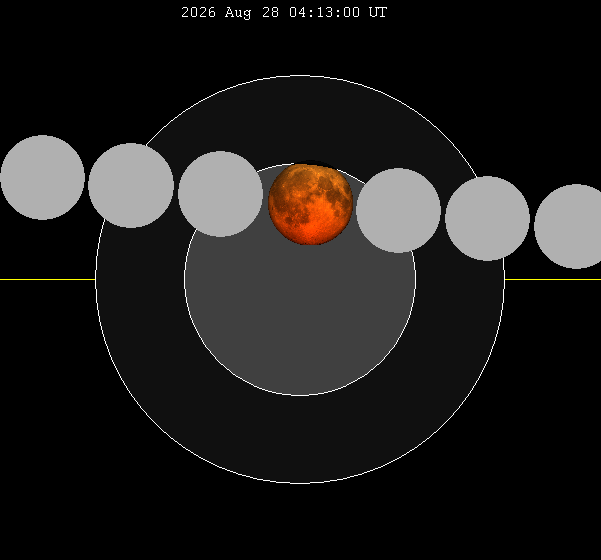
In a partial lunar eclipse, one part of the Moon is in the Earth's umbra, while the other part remains in the Earth's penumbra. The August 2026 eclipse is an unusually deep partial: the Moon's disk will be almost entirely swallowed by the umbra, with only a thin bright rim remaining at maximum eclipse. That's why it will look far more dramatic than a typical partial eclipse.
Here's the surprising part: the Moon orbits Earth every month, yet we don't get an eclipse every full moon. The reason is that the Moon's orbit is tilted about five degrees relative to Earth's orbit around the Sun. Most months, the full Moon passes slightly above or below Earth's shadow and misses it entirely. Only when a full moon aligns near one of the two points where the Moon's orbit crosses Earth's orbital plane — called nodes — can an eclipse occur. The August 2026 eclipse happens when the Moon reaches its ascending node, which is why the alignment is precise enough to cast Earth's shadow across the lunar disk.
Why the Moon Turns a Coppery Red
During the deepest phase of a lunar eclipse, the shadowed portion of the Moon can take on a reddish or coppery glow. This happens because sunlight still reaches the Moon indirectly — bending around Earth and passing through our atmosphere. Earth's air scatters away the shorter, bluer wavelengths of light, while the longer red and orange wavelengths bend toward the Moon and illuminate it. The same effect that paints sunrises and sunsets in warm colors is what can tint an eclipsed Moon red.
Because the August 2026 eclipse is partial rather than total, only the portion of the Moon inside the umbra will darken dramatically, while the remaining sliver stays bright. Observers watching from beginning to end will see the shadow creep across the lunar surface, deepen to near-totality, and then recede — a slow, graceful transformation visible to the naked eye.
When and Where to See It: A Complete Timeline
The eclipse unfolds over more than five hours from first contact to last, with the partial phase alone lasting 3 hours and 19 minutes. Here are the key moments in Universal Time (UTC): the penumbral eclipse begins at 1:23 UTC, the partial eclipse begins at 2:33 UTC, greatest eclipse arrives at 4:12 UTC, the partial eclipse ends at 5:52 UTC, and the penumbral eclipse ends at 7:02 UTC.
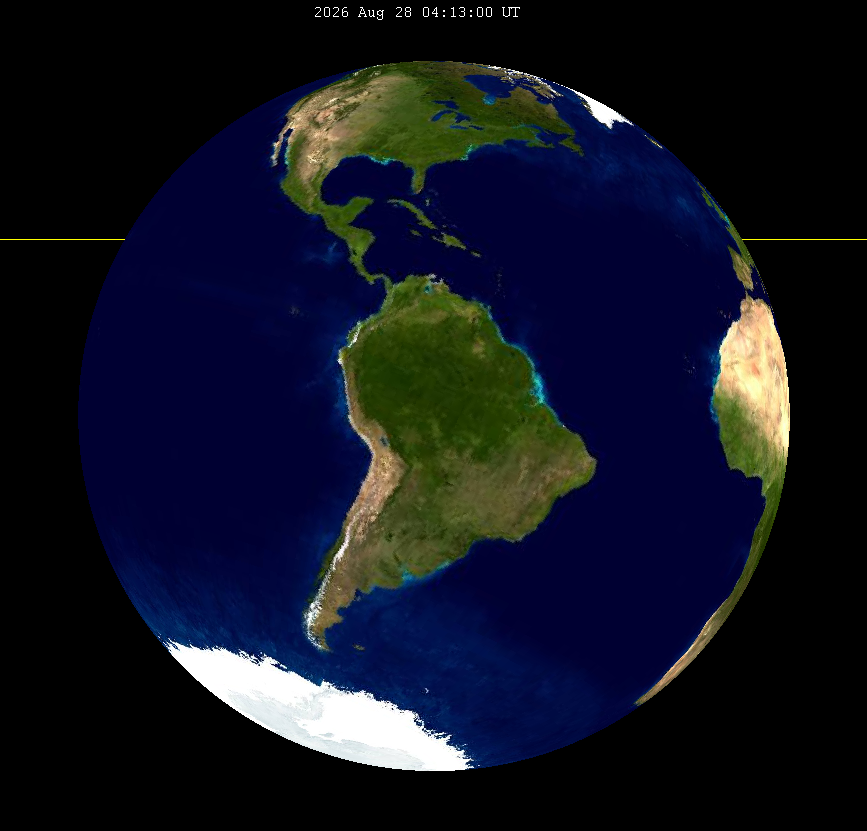
For viewers in North America, that translates to a convenient late-evening show. The partial phase begins around 10:33 p.m. Eastern (7:33 p.m. Pacific) on August 27, with greatest eclipse at about 12:12 a.m. Eastern (9:12 p.m. Pacific) on August 28. South America sees the event high in the night sky, while observers in the central Pacific will watch the Moon rise already in eclipse. In Europe, Africa, and the Middle East, the Moon will be setting as the eclipse progresses, so viewers there will catch only the earlier stages before moonset.
The eclipse is completely visible over North and South America, which are ideally positioned on the night side of Earth at the right moment. Unlike a solar eclipse — visible only from a narrow path — a lunar eclipse can be seen from anywhere on Earth where the Moon is above the horizon during the event.
How to Watch the August 2026 Eclipse
One of the best things about a lunar eclipse is that it requires no special equipment. You can watch it safely with your eyes alone, and binoculars or a small telescope will simply reveal more detail in the shadow's edge and the Moon's craters. For the clearest view, find a spot away from bright city lights and give your eyes a few minutes to adjust to the dark. Check your local moonrise and moonset times to plan the best window, since the exact timing varies by time zone.
What Comes Next After August 2026
Once the August 28 eclipse concludes, the Moon will return to its normal bright full phase, and the next lunar eclipse won't arrive until February 2027, when a subtle penumbral eclipse occurs. Total lunar eclipses are even rarer treats — the next total lunar eclipse after this series will not happen until 2029. That long wait is part of what makes the August 2026 deep partial eclipse, the capstone of an almost tetrad, such a noteworthy event for skywatchers.
The Bottom Line: What to Remember
Here's the short version of what you need to know about the August 2026 lunar eclipse:
- A deep partial lunar eclipse occurs on August 28, 2026, covering about 93 percent of the Moon in Earth's umbra.
- It is fully visible across North and South America, with the Moon setting mid-eclipse for Europe and Africa.
- Greatest eclipse is at 4:12 UTC — roughly midnight Eastern time on the night of August 27–28.
- It is the last of an "almost tetrad" that featured three total lunar eclipses in 2025 and 2026.
- No special equipment is needed; just look up and enjoy the show.