The Moon will slide directly between Earth and the Sun on August 12, 2026, casting a shadow that will sweep across the Arctic, the North Atlantic, and parts of Europe. For the first time in nearly three decades, mainland Europe will witness a total solar eclipse — a rare celestial event where day briefly turns to night and the Sun's ethereal outer atmosphere, the corona, becomes visible to the naked eye.
The Science Behind a Solar Eclipse: Why Day Turns to Night
A total solar eclipse happens because of a remarkable cosmic coincidence. The Sun is roughly 400 times larger than the Moon, but it is also about 400 times farther away from Earth. This means that from our vantage point, the two celestial bodies appear almost exactly the same size in the sky. When the Moon's orbit carries it directly between Earth and the Sun, it can perfectly cover the Sun's bright face, or photosphere, plunging the area beneath the Moon's dark inner shadow — the umbra — into an eerie twilight.
During totality, which can last anywhere from a few seconds to over seven minutes depending on the specific geometry, the Sun's corona becomes visible. This wispy, pearl-white halo of superheated plasma is normally invisible, washed out by the Sun's glare. For many who experience it, those precious minutes of totality are nothing short of life-changing. Temperatures can drop by several degrees, birds may stop singing, and stars and planets become visible in the middle of the day.
There are actually three types of solar eclipses: total, partial, and annular. A total solar eclipse occurs when the Moon completely covers the Sun. A partial eclipse happens when the alignment is imperfect and only part of the Sun is obscured. An annular eclipse — sometimes called a "ring of fire" — occurs when the Moon is slightly farther from Earth in its elliptical orbit and appears too small to fully cover the Sun, leaving a bright ring around the dark lunar disk. The August 2026 event will be a total solar eclipse.
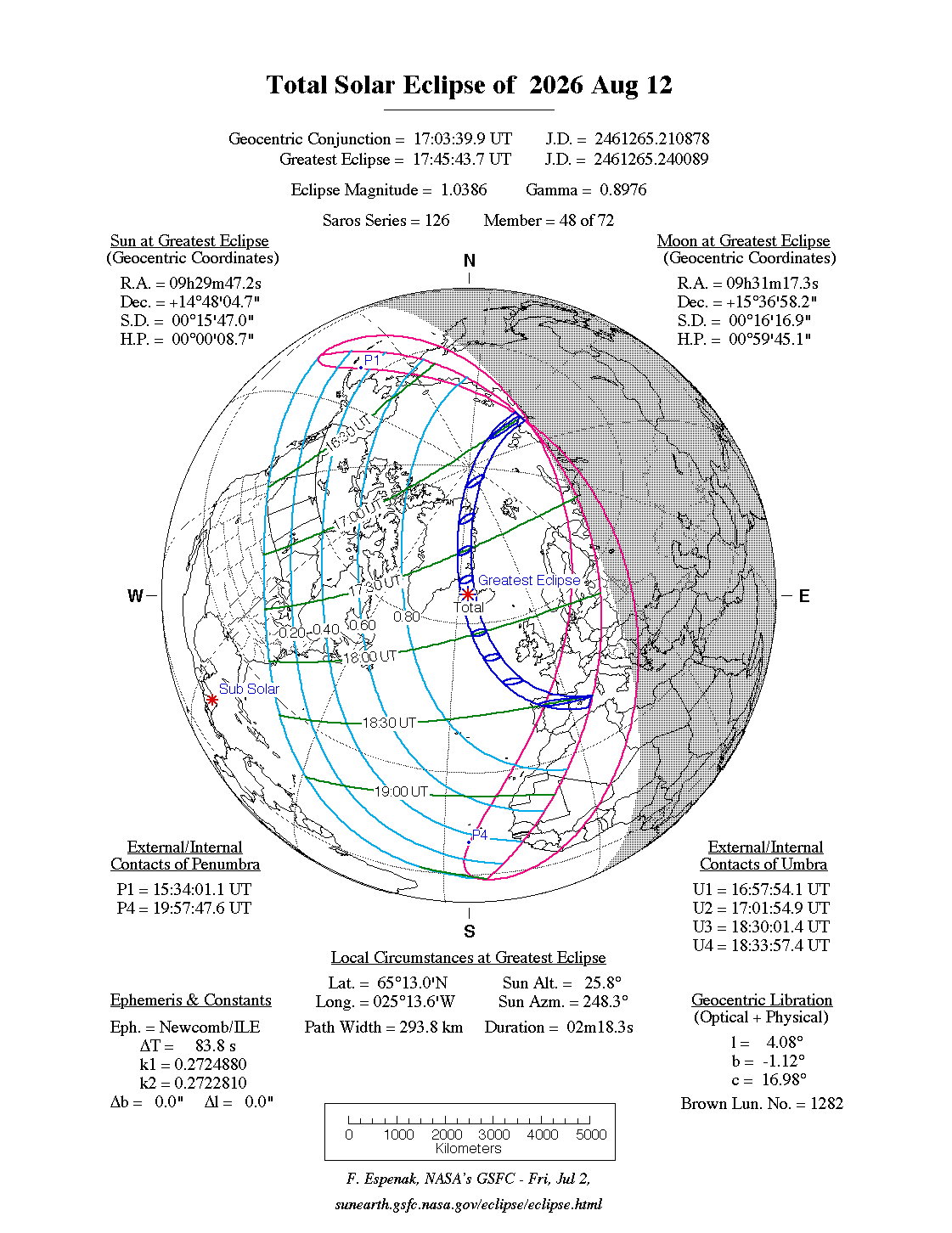
Where and When: The 2026 Eclipse Path Across the Globe
The total solar eclipse of August 12, 2026, will follow a dramatic path that begins in the remote wilderness of the Arctic and ends at sunset in the warm waters of the Mediterranean Sea. The Moon's shadow first touches Earth's surface in the far North Atlantic, then races northeast across the Arctic Ocean before sweeping over Greenland.
From Greenland, the shadow crosses the Denmark Strait and reaches western Iceland — including the capital city of Reykjavík — where totality will be visible for roughly one to two minutes depending on exact location. Iceland is expected to be one of the most popular destinations for eclipse chasers, though weather in August can be unpredictable.
After leaving Iceland, the shadow traverses the North Atlantic for hundreds of miles before making landfall in northern Spain. This is where the eclipse becomes most accessible to viewers. The path of totality enters Spain near the city of Gijón on the Bay of Biscay coast, then cuts southeast across the country. Major Spanish cities that lie within or very near the path include Santander, Bilbao, Burgos, Zaragoza, and Valencia. Further east, the island of Palma de Mallorca also falls under the Moon's shadow.
The eclipse ends at sunset in the Mediterranean Sea near the Balearic Islands, creating what astronomers call a "sunset eclipse" — a rare and dramatic sight where the eclipsed Sun appears to set while still in totality. The maximum duration of totality for this eclipse will be approximately 2 minutes and 18 seconds, occurring over the North Atlantic west of Iceland. The path will be roughly 293 kilometers (182 miles) wide at its maximum.
How to View a Solar Eclipse Without Damaging Your Eyes
Looking directly at the Sun is dangerous at any time, but during a solar eclipse, the temptation is strong to glance upward. The intense solar radiation can cause permanent retinal damage — a condition called solar retinopathy — in a matter of seconds, and because the retina lacks pain receptors, the damage occurs without any immediate sensation.
The only safe way to look directly at a partial or annular eclipse is through specialized eye protection. Regular sunglasses, no matter how dark, are never sufficient. Neither are homemade filters, smoked glass, or unverified materials. The international safety standard for solar viewers is ISO 12312-2, and viewers should always check that their eclipse glasses are undamaged, unscratched, and manufactured by a reputable company.
During the brief period of totality — and only during totality — it is safe to look at the Sun without filters. In fact, removing your glasses during totality is essential for seeing the corona. But the moment the Sun begins to re-emerge, viewers must immediately replace their protective eyewear.
For those who cannot obtain certified eclipse glasses, indirect viewing methods work brilliantly. The simplest is a pinhole projector: poke a small hole in a piece of card, hold it up to the Sun, and project the image onto a second piece of paper or a flat surface below. Even a kitchen colander or the gaps between tree leaves can create dozens of tiny crescent Sun projections on the ground. Telescopes, binoculars, and cameras must be fitted with proper solar filters — pointing unfiltered optical instruments at the Sun can cause instant and severe eye injury.
Why the 2026 Eclipse Is Generating So Much Excitement
The 2026 total solar eclipse is significant for several reasons. It will be the first total solar eclipse visible from mainland Europe since August 11, 1999 — a gap of 27 years. That 1999 eclipse was one of the most widely viewed total solar eclipses in history, passing over the United Kingdom, France, Germany, and several other European nations. The 2026 event offers a new generation of Europeans the chance to experience totality without crossing an ocean.
Spain, in particular, is a compelling destination. August is peak summer, and while some parts of northern Spain can experience cloud cover, the Mediterranean coast and Zaragoza area offer statistically better chances of clear skies. The path also crosses major cities with excellent infrastructure — making travel and accommodation planning much easier than for eclipses that occur over open ocean or remote regions.
Astronomically, the 2026 eclipse belongs to Saros series 126, a family of eclipses that repeats every 18 years and 11 days. This same series produced the total solar eclipse of August 1, 2008, which crossed northern Canada, Greenland, Siberia, and China. Each successive eclipse in a Saros series shifts slightly northward or southward, and the 2026 event continues this gradual migration.
Tips for Planning Your Eclipse Trip
If you are considering traveling to see the 2026 total solar eclipse, now is the time to start planning. Hotels and accommodations in the path of totality often book up years in advance, especially in popular cities like Reykjavík and Valencia. Here are a few practical tips:
First, prioritize mobility over a single fixed location. The weather on eclipse day is never guaranteed, and the ability to drive to a clearer area can make the difference between seeing totality and watching clouds darken. Second, arrive at your viewing site well in advance — eclipse day brings heavy traffic. Third, bring more than one pair of certified eclipse glasses, and practice using your cameras or telescopes beforehand. Finally, remember that the experience of totality is sensory and emotional as much as visual — many veteran eclipse chasers recommend putting down the camera for at least part of totality and simply watching with your own eyes.
What to Expect When Day Turns to Night
The experience of a total solar eclipse unfolds in distinct stages. About an hour before totality, the partial phase begins as the Moon takes its first bite from the Sun's disk. Over the next hour, the landscape dims subtly and shadows grow sharper. In the final moments before totality, shadow bands — thin, wavy lines of alternating light and dark — may ripple across the ground. The temperature drops, and a 360-degree sunset effect can appear on the horizon.
Then, totality arrives. The last bead of sunlight, known as the diamond ring effect, flashes brilliantly before the corona emerges in its full glory. For roughly two minutes, day becomes night. Bright stars and planets appear. The corona stretches outward in a shape determined by the Sun's magnetic field. Then, all too soon, the diamond ring reappears on the opposite side, and totality is over. The entire cycle reverses over the following hour.
For those who witness it, a total solar eclipse is often described as one of the most profound natural experiences a person can have. Mark Twain once wrote that "the wonder of it" was something that stayed with you forever. On August 12, 2026, millions will have their chance to feel that wonder for themselves.