Colombia is one of the most seismically active countries in the Western Hemisphere. Sitting at the crossroads of five major tectonic plates along the notorious Pacific Ring of Fire, the country experiences hundreds of earthquakes every year — though most are too small to feel. Understanding why these tremors happen isn't just a matter of scientific curiosity; it's a matter of public safety for the millions of people living in cities like Bogotá, Medellín, and Cali.
At its core, an earthquake is the shaking of the Earth's surface caused by a sudden release of energy in the planet's crust. This energy travels outward in the form of seismic waves, which can range from barely perceptible vibrations to violent jolts capable of leveling entire city blocks. The word itself — from the Greek seismos meaning "shaking" — captures the essence of what happens when immense geological forces that have been building for decades or even centuries are released in a matter of seconds.
The Tectonic Puzzle: Five Plates, One Country
To grasp why Colombia is so earthquake-prone, you need to look beneath the surface — literally. The country sits at the boundaries of five tectonic plates: the Malpelo Plate, the Panama Plate, the Caribbean Plate, the North Andes Plate, and the massive South American Plate. Most of Colombia's earthquakes occur along the boundary where the North Andes Plate interacts with its neighbors.
The 1906 Ecuador-Colombia earthquake — the strongest ever recorded in the region — was a megathrust earthquake along the subduction zone where the Malpelo Plate dives beneath South America. With a moment magnitude of 8.8, it generated a tsunami with waves up to 5 meters (16 feet) high and caused approximately 1,000 deaths. To put that magnitude in perspective: an 8.8 earthquake releases roughly 1,000 times more energy than the atomic bomb dropped on Hiroshima.
A History Written in Tremors: Colombia's Most Significant Earthquakes
The first historically recorded earthquake felt in what is now Colombia struck on September 11, 1530, with its epicenter likely near Cumaná in present-day Venezuela. The first quake with an epicenter confirmed within Colombia's borders occurred in 1566 near Santander in the department of Cauca. Since then, the country's seismic history has been punctuated by devastating events.
The single deadliest seismic disaster connected to Colombia was the pair of earthquakes on August 15 and 16, 1868, off the coast of Ecuador, which claimed approximately 70,000 lives. The 1875 Cúcuta earthquake, estimated at magnitude 7.5, killed around 10,000 people and destroyed much of the border city. In more recent memory, the 1999 Armenia earthquake — centered in Colombia's coffee-growing heartland — left widespread destruction and reshaped the country's approach to seismic building codes. The 1983 Popayán earthquake similarly devastated the colonial city, destroying many of its historic churches and buildings.
Interestingly, the 1785 earthquake centered near La Calera, Cundinamarca, sparked the birth of journalism in Colombia. Six years after the quake, Manuel del Socorro Rodríguez published the Aviso del Terremoto (Earthquake Notice), widely considered the first example of journalistic reporting in Colombian history.
How to Stay Safe When the Ground Shakes: The Drop, Cover, Hold On Method
Knowing the science is valuable, but knowing what to do during an earthquake can save your life. Emergency management agencies worldwide, including FEMA and the Colombian Geological Service, recommend the same three-step protocol: Drop, Cover, and Hold On.
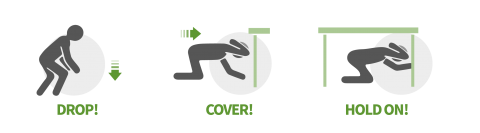
Step one: Drop. As soon as you feel shaking, drop down onto your hands and knees. This position prevents the earthquake from knocking you over and allows you to move if necessary. Step two: Cover. Use one arm to cover your head and neck. If a sturdy table or desk is nearby, crawl underneath it for shelter. If no shelter is available, crawl next to an interior wall, away from windows, and stay on your knees while bending over to protect your vital organs. Step three: Hold On. Grip your shelter with one hand and be prepared to move with it if it shifts. If you're not under shelter, hold on to your head and neck with both arms. Stay in this position until the shaking completely stops.
For people who use a cane, the same principles apply: drop, cover, and hold on — or sit on a chair or bed and cover your head and neck with both hands. For those using a walker or wheelchair, lock the wheels, bend over as low as possible, and cover your head and neck with your arms, a book, or a pillow.
After the Shaking Stops: What Comes Next
The danger doesn't end when the ground stops moving. Aftershocks — smaller earthquakes that follow the main shock — can occur for days, weeks, or even months afterward. These can be powerful enough to collapse structures weakened by the initial quake, so staying alert is crucial. If you're in a damaged building, move outside and away from it as quickly as possible. Do not re-enter damaged buildings.
If you find yourself trapped, send a text message rather than making a phone call — texts use less battery and are more likely to get through when networks are congested. Bang on a pipe or wall to alert rescuers, and cover your mouth with your shirt to protect against dust and debris. If you're in a coastal area, be aware that large offshore earthquakes can trigger tsunamis — head to higher ground immediately if you experience strong shaking near the coast.
Once safe, monitor local news via battery-operated radio, social media, or text alerts for emergency instructions. Use social media or text messages to let loved ones know you're okay — phone lines are often overwhelmed after major quakes. When cleaning up debris, wear protective clothing including long sleeves, sturdy shoes, and work gloves.
The Bottom Line: Living With an Unpredictable Earth
Colombia will continue to experience earthquakes — that is an unavoidable geological reality. The country's position atop five tectonic plates, its location on the Pacific Ring of Fire, and its network of active fault systems ensure that seismic activity will remain a constant feature of life in the Andean nation. But understanding the science behind these events — the subduction of plates, the buildup and release of elastic strain along faults, and the three ways the earth can rupture — transforms earthquakes from terrifying mysteries into predictable natural phenomena.
Combined with practical safety knowledge like the Drop, Cover, and Hold On protocol, this understanding empowers Colombians and visitors alike to face the next tremor not with panic, but with preparedness. As one USGS seismologist famously put it: "Earthquakes don't kill people — buildings do." Knowing how to protect yourself is the single most important step you can take.